

Good writing is more than correct grammar. It also uses clear words, descriptive language, and creative techniques to help readers understand ideas. Writers often improve their work with figurative language, similes, metaphors, idioms, and vivid expressions. These tools make stories more interesting, essays more persuasive, and conversations easier to follow. However, even the most creative writing can lose its impact if basic grammar mistakes confuse the reader.
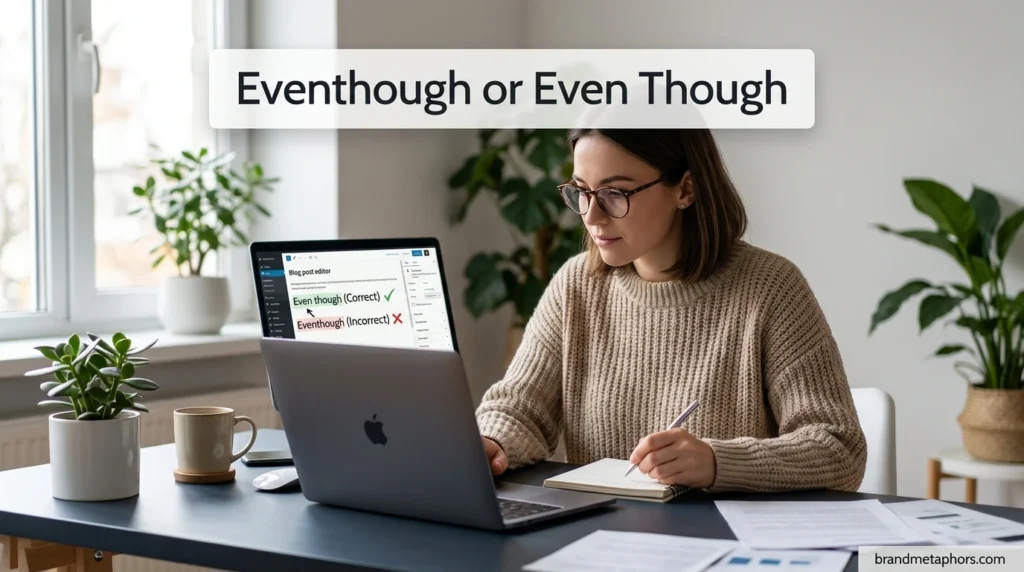
One common mistake many students, writers, and English learners make is writing “eventhough” instead of “even though.” At first glance, both forms may seem acceptable because they sound the same when spoken. However, only one is considered correct in standard English.
Understanding this difference will improve your grammar, writing skills, vocabulary, and confidence. In this guide, you’ll learn the correct spelling, grammar rules, examples, common mistakes, comparisons, exercises, and practical tips to use this expression naturally in everyday writing.
What Does “Even Though” Mean?
Even though is a conjunction that introduces a contrast between two ideas. It means:
- Despite the fact that
- Although
- Though
- In spite of the fact that
It connects two clauses where one idea is surprising or unexpected compared to the other.
Structure
Even though + subject + verb, main clause
or
Main clause + even though + subject + verb
Examples
- Even though it was raining, we went hiking.
- She smiled even though she felt nervous.
- Even though he studied hard, the test was difficult.
- I enjoyed the movie even though it was very long.
In each sentence, the second idea contrasts with what you might normally expect.
Is “Eventhough” a Word?
No.
Eventhough is not a correct English word.
It is simply a spelling mistake created by joining two separate words together.
Correct
✅ even though
Incorrect
❌ eventhough
Most dictionaries, grammar books, teachers, publishers, and style guides recognize only even though as the standard form.
Why People Make This Mistake
People often hear the phrase spoken quickly.
For example:
Even though → sounds like → eventhough
Because the pronunciation is smooth, many learners think it is written as one word.
However, English spelling follows grammar rules rather than pronunciation alone.
Why “Even Though” Is Written as Two Words
English contains many multi-word conjunctions.
Examples include:
Correct PhrasePurposeeven thoughcontrastas long asconditionso thatpurposerather thancomparisoneven ifpossibility
These expressions remain separate because each word contributes to the overall meaning.
In even though:
- even adds emphasis.
- though introduces contrast.
Together they create a stronger meaning than simply saying though.
Even Though vs Although vs Though
Many conjunctions express contrast. Understanding their differences helps improve writing.
ExpressionFormalityMeaningExampleeven thoughneutralstrong contrastEven though it snowed, school stayed open.althoughformalcontrastAlthough he apologized, she remained upset.thoughinformalcontrastThough I was tired, I finished.despiteformaldespite somethingDespite the rain, we played.in spite offormaldespite somethingIn spite of traffic, we arrived early.
Which Is Stronger?
“Even though” usually emphasizes the contrast more than “although.”
Compare:
Although she was sick, she worked.
Even though she was sick, she worked.
The second sentence sounds stronger because it highlights the unexpected situation.
How to Use “Even Though” Correctly
The phrase can appear at the beginning or middle of a sentence.
At the Beginning
- Even though I was busy, I answered the phone.
- Even though she practiced daily, she was still nervous.
- Even though the road was icy, they continued driving.
In the Middle
- We enjoyed the picnic even though it became windy.
- He kept smiling even though he was exhausted.
- She bought the dress even though it was expensive.
Both positions are grammatically correct.
Common Mistakes Students Make
Learning grammar becomes easier when you recognize common errors.
Mistake 1: Writing One Word
❌ Eventhough I tried, I failed.
✅ Even though I tried, I failed.
Mistake 2: Confusing with Even If
Incorrect:
Even though you study tomorrow, you’ll pass.
Correct:
Even if you study tomorrow, you’ll pass.
Even though refers to real situations.
Even if refers to possible or imaginary situations.
Mistake 3: Missing the Comma
When the phrase begins the sentence, use a comma.
Correct:
Even though it was late, we kept working.
Incorrect:
Even though it was late we kept working.
Mistake 4: Using Double Contrast
Incorrect:
Although but he apologized…
Correct:
Although he apologized…
Correct:
But he apologized…
Never use both together.
Sentence Examples for Everyday Writing
School
- Even though the homework was difficult, everyone finished.
- Even though the classroom was noisy, she concentrated.
- Even though he forgot his notes, he gave a great presentation.
Workplace
- Even though the meeting lasted two hours, nobody complained.
- Even though sales dropped, the company stayed profitable.
- She accepted the project even though it required extra work.
Family
- Even though my brother is younger, he gives excellent advice.
- We celebrated even though the weather was terrible.
- Even though our vacation ended, we kept wonderful memories.
Sports
- Even though they lost the first game, they won the championship.
- Even though he was injured, he supported his teammates.
- She finished the race even though she felt tired.
Using “Even Though” in Creative Writing
Creative writing becomes more engaging when writers combine strong grammar with vivid language.
The phrase often creates emotional contrast.
Examples:
- Even though darkness surrounded the village, hope still glowed.
- Even though winter covered the fields, tiny flowers appeared.
- Even though fear whispered loudly, courage answered softly.
These examples create stronger emotional impact.
Combining with Descriptive Language
Instead of:
He continued walking.
Write:
Even though icy winds pushed against him, he continued walking with quiet determination.
The sentence becomes more visual and interesting.
Figurative Language and “Even Though”
Figurative language makes writing richer by expressing ideas imaginatively rather than literally. While even though itself is a conjunction—not a figurative device—it often introduces contrasts that strengthen figurative expressions.
Metaphor Examples
- Even though life is a roller coaster, every climb teaches patience.
- Even though time is a thief, memories remain.
- Even though hope is a tiny candle, it lights the darkest room.
Simile Examples
- Even though she was nervous, she stood like a mountain.
- Even though he was tired, he worked like a machine.
- Even though the child was frightened, she smiled like sunshine.
Idiom Examples
- Even though he was under the weather, he attended class.
- Even though the team hit a roadblock, they never gave up.
- Even though she was on cloud nine, she stayed humble.
Poetic Expression
Poets frequently use contrast to create emotion.
Example:
Even though the stars disappeared, Morning carried new promises.
The contrast between darkness and hope adds beauty to the writing.
Tone and Style Usage
Choosing the right expression depends on your writing style.
Writing TypeSuitable?ExampleAcademic writingYesEven though the results differed, the conclusion remained valid.EssaysYesEven though the evidence was limited, researchers continued studying.StoriesYesEven though the castle looked abandoned, someone lived inside.EmailsYesEven though I am busy, I will reply soon.SpeechesYesEven though challenges exist, we will succeed together.
The phrase works well in both formal and informal communication.
When to Use and When to Avoid

Use It When
- Showing unexpected contrast
- Comparing opposite ideas
- Writing essays
- Creating emotional storytelling
- Improving sentence variety
- Explaining surprising situations
Examples:
- Even though she apologized, he remained upset.
- Even though it was expensive, they bought it.
Avoid It When
Avoid repeating it too often.
Instead, vary your writing with:
- although
- though
- despite
- however
- nevertheless
- still
- yet
Using different connectors improves vocabulary and readability.
Quick Comparison Table
IncorrectCorrectReasoneventhougheven thoughStandard spellingevenifeven ifTwo separate wordsatleastat leastTwo separate wordsalota lotTwo separate wordsinspitein spiteUsually written as two words in this phrase
Notice a pattern.
Many English expressions consist of separate words rather than one combined word.
Practice Exercises
Exercise 1
Choose the correct form.
- Eventhough / Even though it was cold, we went outside.
Answer:
Even though
Eventhough / Even though she studied, she felt nervous.
Answer:
Even though
Even though / Even if it rains tomorrow, we’ll stay home.
Answer:
Even if
Exercise 2
Correct the mistake.
- Eventhough I tried, I failed.
Answer:
Even though I tried, I failed.
Although but he came.
Answer:
Although he came.
or
But he came.
Even though she was tired she continued.
Answer:
Even though she was tired, she continued.
Exercise 3
Complete the sentences.
- Even though ____________, I smiled.
- Even though ____________, we finished the project.
- Even though ____________, they kept practicing.
Possible answers vary.
Tips to Remember the Correct Spelling
- Think of even and though as two separate words working together.
- Read carefully before submitting essays.
- Use grammar checkers, but don’t rely on them completely.
- Practice writing complete sentences every day.
- Read books and articles to become familiar with correct usage.
- Notice how professional writers separate the words.
- Proofread slowly, especially after typing quickly.
The more you read and write, the more natural the correct spelling becomes.
Frequently Asked Questions
1. Is “eventhough” ever correct?
No. It is considered a spelling mistake. The correct form is even though.
2. Can “even though” start a sentence?
Yes. When it begins a sentence, place a comma after the introductory clause.
Example:
Even though it was raining, we enjoyed the picnic.
3. What is the difference between “even though” and “even if”?
Even though describes a real situation.
Even if describes a possible or hypothetical situation.
4. Is “even though” formal or informal?
It is suitable for both formal and informal writing, including essays, reports, emails, and stories.
5. How can I avoid spelling it incorrectly?
Remember that it is made of two separate words. Reading regularly, proofreading your work, and practicing grammar exercises will help build the habit of writing it correctly.
Conclusion
Understanding the difference between eventhough and even though is a simple but important step toward better English. While the incorrect one-word spelling appears frequently in casual typing, only the two-word phrase is accepted in standard English. Because it introduces a strong contrast between ideas, it is useful in academic writing, creative stories, professional communication, and everyday conversations.
Mastering this expression also strengthens your overall writing skills. When combined with descriptive language, figurative language, metaphors, similes, idioms, and thoughtful sentence structure, it helps create clear, engaging, and memorable writing. By practicing the examples, avoiding common mistakes, and using the exercises in this guide, you’ll gain confidence and communicate more effectively in every type of writing.