
Introduction
Strong writing is more than using correct grammar—it is about choosing the right words to express ideas clearly and effectively. Whether you are writing essays, stories, emails, or professional documents, understanding similar-looking words helps improve accuracy and confidence. Figurative language, descriptive language, and carefully selected vocabulary also make communication more engaging. Literary devices such as metaphors, similes, and idioms enrich writing, while precise word choice prevents misunderstandings.
Among commonly confused English words, tear vs tare often creates confusion because they are spelled similarly but have completely different meanings. One belongs to everyday English and literature, while the other is mostly used in commerce, weighing, science, and packaging. Learning the distinction helps students, writers, and English learners avoid common mistakes and strengthen their writing skills.
This comprehensive guide explains the meanings, pronunciation, grammar, usage, examples, comparisons, and practical applications of these two words. You’ll also discover creative writing examples, figurative language connections, vocabulary enhancement tips, practice exercises, and frequently asked questions.
What Does “Tear” Mean?
The word tear has several meanings depending on pronunciation and context.
Meaning 1: To Rip or Split Something
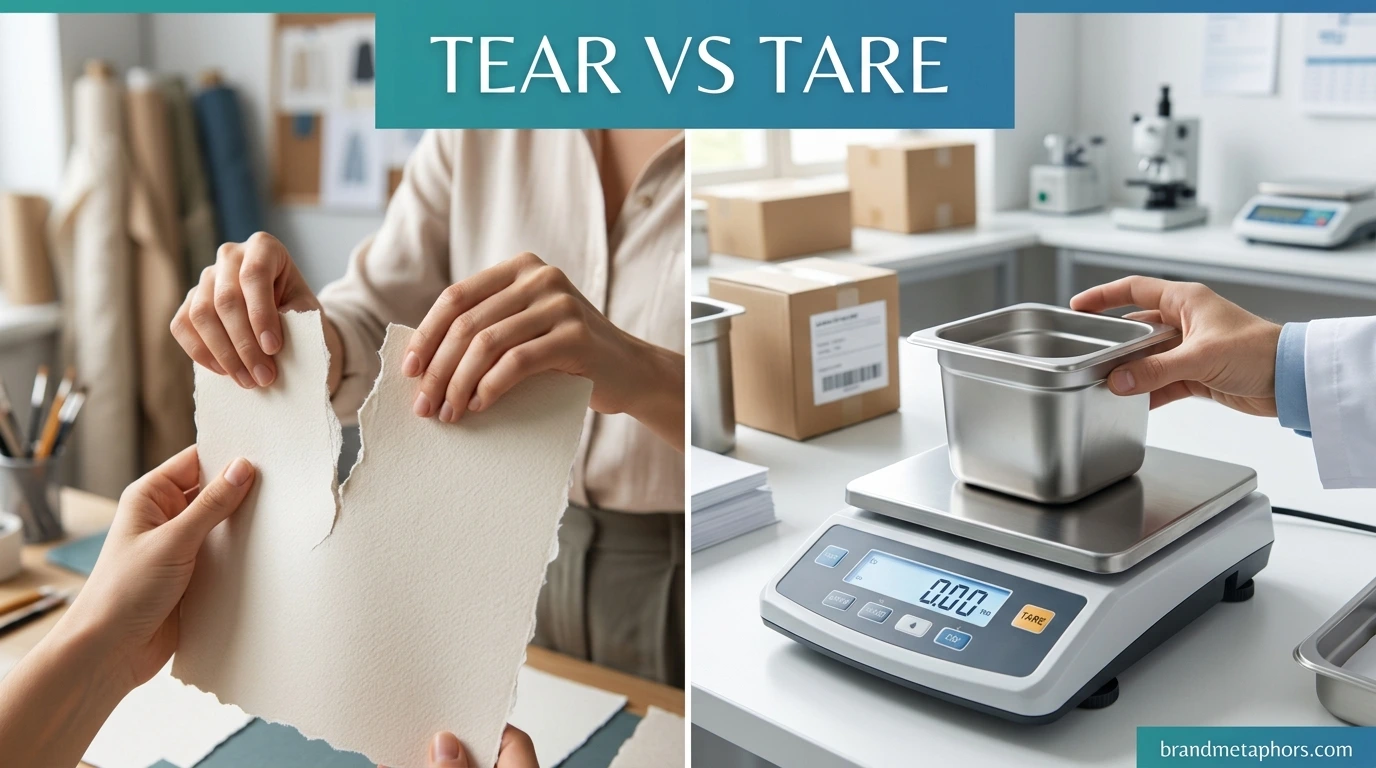
When pronounced “tair” (/teər/), it means to rip, break, or separate material by pulling.
Examples:
- Be careful not to tear the paper.
- She accidentally tore her favorite dress.
- Strong winds can tear down weak structures.
- Don’t tear the pages from the notebook.
Meaning 2: A Drop of Water from the Eye
When pronounced “teer” (/tɪər/), a tear refers to the liquid produced by the eyes due to emotion or irritation.
Examples:
- A single tear rolled down his cheek.
- Tears filled her eyes with happiness.
- The emotional speech brought tears to everyone.
Grammar Forms
FormExampleBase VerbtearPast TensetorePast ParticipletornPresent ParticipletearingNountear
What Does “Tare” Mean?
The word tare is much less common in everyday English but very important in technical, commercial, and scientific settings.
Definition
Tare is the weight of a container or package that is deducted from the total weight to determine the net weight of its contents.
For example:
Gross Weight − Tare Weight = Net Weight
Examples
- The cashier pressed the tare button before weighing the vegetables.
- The empty bucket’s tare weight is one kilogram.
- Always subtract the tare to find the actual product weight.
- Laboratories use tare functions for accurate measurements.
Unlike “tear,” tare is almost never associated with emotions or ripping.
Pronunciation Differences
Although they look alike, pronunciation helps distinguish them.
WordPronunciationMeaningTear (rip)/teər/Rip apartTear (cry)/tɪər/Drop from the eyeTare/teər/Weight of a container
Notice that tear (rip) and tare sound alike, while tear (cry) has a different pronunciation.
Quick Comparison Table

FeatureTearTarePart of SpeechVerb and nounNoun and verbEveryday UseVery commonTechnicalMain MeaningRip or eye dropContainer weightUsed in LiteratureFrequentlyRarelyEmotional MeaningYesNoScientific UseOccasionallyFrequentlyBusiness UseRarelyCommonCreative WritingVery commonAlmost never
When to Use Tear
Use tear whenever discussing ripping, breaking fabric or paper, emotional crying, or figurative expressions.
Appropriate Situations
- Story writing
- Essays
- Poetry
- Conversations
- Journalism
- Emotional descriptions
- Narrative writing
Examples
- Please don’t tear the photograph.
- His words brought a tear to my eye.
- She tore the envelope carefully.
- The old flag was torn by the storm.
- Children sometimes tear books accidentally.
In descriptive language, tear often conveys emotion, conflict, sadness, relief, or joy.
When to Use Tare
Use tare when discussing measuring weight or using weighing equipment.
Common fields include:
- Shipping
- Grocery stores
- Manufacturing
- Laboratories
- Packaging
- Logistics
- Food production
Examples
- The scale automatically calculates the tare.
- Remove the tare before recording the measurement.
- Every container has a standard tare weight.
- Accurate tare values prevent weighing errors.
Tear in Figurative Language and Creative Writing
Figurative language transforms ordinary writing into memorable expression. Because tear has emotional depth, it frequently appears in creative writing and literary devices.
Metaphor Examples
- Her tears were diamonds of sorrow.
- His torn heart never fully healed.
- Time tears away old memories.
Simile Examples
- Tears flowed like rain.
- The paper tore like thin silk.
- His voice cracked like torn fabric.
Personification Examples
- The storm tore through the village.
- The wind tore at the curtains.
- Silence tore their friendship apart.
Hyperbole
- I cried a river of tears.
- That joke nearly tore me apart with laughter.
Symbolism
A tear often symbolizes:
- Sadness
- Joy
- Relief
- Hope
- Healing
- Regret
- Compassion
Because of these symbolic meanings, writers frequently include tears in novels, speeches, poems, and personal narratives.
Tare in Technical and Professional Writing
Unlike tear, tare is rarely used in creative expression. Instead, it appears in factual, instructional, and professional writing.
Examples include:
Scientific Writing
- Record the tare before adding chemicals.
Business Reports
- Incorrect tare values caused inventory discrepancies.
Manufacturing
- Packaging tare must be standardized.
Shipping
- Gross and tare weights determine transportation costs.
Professional writing values precision, making tare an essential technical term.
Common Idioms and Expressions with Tear
Many English idioms use tear, but almost none use tare.
Tear Someone Apart
Meaning: Criticize someone harshly.
Example: The reviewers tore the movie apart.
Tear Up
Meaning: Become emotional or begin crying.
Example: She teared up during the graduation ceremony.
Tear Down
Meaning: Demolish or destroy.
Example: The city plans to tear down the old building.
Tear Away
Meaning: Leave reluctantly.
Example: He finally tore himself away from the exciting game.
In Tears
Meaning: Crying.
Example: She arrived home in tears.
Sentence Examples for Better Understanding
Tear (Rip)
- Don’t tear the wrapping paper.
- He accidentally tore the map.
- Cats sometimes tear furniture.
- She tore the letter into pieces.
- The rope may tear under pressure.
Tear (Cry)
- A tear rolled down her face.
- Tears expressed what words could not.
- He wiped away every tear.
- Joyful tears filled the room.
- The ending caused many tears.
Tare
- Enter the tare before measuring.
- The digital scale includes a tare function.
- Check the tare weight carefully.
- Incorrect tare affects the final calculation.
- Packaging labels often include tare information.
Common Mistakes Learners Make
Mistake 1
❌ The cashier pressed the tear button.
✅ The cashier pressed the tare button.
Mistake 2
❌ Tears are deducted from gross weight.
✅ Tare is deducted from gross weight.
Mistake 3
❌ She had a tare in her eye.
✅ She had a tear in her eye.
Mistake 4
❌ Please tare this piece of paper.
✅ Please tear this piece of paper.
Mistake 5
Confusing pronunciation.
Remember:
- Tear (cry) sounds like “teer.”
- Tear (rip) sounds like “tair.”
- Tare sounds like “tair.”
Writing Skills and Vocabulary Enhancement
Improving vocabulary means understanding subtle differences between similar words.
Tips
- Learn words in context rather than memorizing definitions.
- Read newspapers, novels, and academic articles.
- Practice sentence writing.
- Notice pronunciation differences.
- Keep a vocabulary journal.
- Review commonly confused word pairs.
Expanding vocabulary improves:
- Academic writing
- Creative writing
- Business communication
- Public speaking
- Reading comprehension
When to Avoid Using Each Word

Avoid Using “Tear”
Avoid using tear when discussing measurements, shipping, packaging, or weighing equipment.
Incorrect:
- The tear weight is five kilograms.
Correct:
- The tare weight is five kilograms.
Avoid Using “Tare”
Avoid using tare in emotional, literary, or everyday situations involving ripping or crying.
Incorrect:
- A tare rolled down her cheek.
Correct:
- A tear rolled down her cheek.
Practice Exercises
Exercise 1
Choose the correct word.
- The scale automatically subtracts the ______.
- Don’t ______ the document.
- A ______ rolled down his cheek.
- Check the container’s ______ weight.
- She accidentally ______ the envelope.
Answers
- tare
- tear
- tear
- tare
- tore
Exercise 2
Correct the mistakes.
- Please tare the paper in half.
- The grocery scale has no tear function.
- His tare showed great sadness.
- Remove the tear weight first.
Correct Answers
- Please tear the paper in half.
- The grocery scale has no tare function.
- His tear showed great sadness.
- Remove the tare weight first.
Memory Tricks
Remember these simple associations:
Tear
Think:
- Tears from your eyes.
- Tearing paper.
- Emotional stories.
Tare
Think:
- Truck scales.
- Grocery scales.
- Shipping containers.
- Measuring equipment.
A helpful memory tip:
Tare starts with “Ta,” like “Table scale.”
Real-Life Examples
At School
“Don’t tear your assignment.”
At the Grocery Store
“The cashier pressed the tare button before weighing the fruit.”
During a Movie
“A tear rolled down everyone’s face.”
In a Warehouse
“The shipment’s tare weight was recorded before loading.”
In a Science Lab
“Students reset the balance using the tare function.”
Why Understanding the Difference Matters
Using the correct word improves communication and prevents confusion.
Benefits include:
- Better academic performance
- More accurate professional writing
- Stronger vocabulary
- Improved reading comprehension
- Higher confidence in English
- Better standardized test performance
- Clearer technical communication
- More expressive creative writing
Even though “tare” appears less frequently, understanding it demonstrates advanced vocabulary knowledge.
Frequently Asked Questions
1. Are tear and tare interchangeable?
No. They have completely different meanings. Tear relates to ripping or crying, while tare refers to container weight used in measurements.
2. Why does “tear” have two pronunciations?
English contains heteronyms—words with the same spelling but different pronunciations and meanings. “Tear” is one such example.
3. Is tare commonly used in everyday conversation?
Not usually. It mainly appears in grocery stores, laboratories, factories, shipping, logistics, and packaging industries.
4. Which word is more common in literature?
“Tear” appears frequently because it expresses action and emotion. “Tare” is rarely used in novels or poetry.
5. How can I remember the difference?
Associate tear with eyes and ripping, while tare belongs to scales, measurements, and weighing containers.
Conclusion
Although tear and tare look similar, their meanings belong to entirely different areas of English. Tear refers to ripping something apart or the drops produced by our eyes, making it a common word in everyday speech, storytelling, poetry, and figurative language. It appears in metaphors, similes, idioms, and descriptive language, helping writers create vivid emotional imagery and strengthen creative writing.
Tare, on the other hand, is a specialized term used in weighing, shipping, laboratories, manufacturing, and commerce. It represents the weight of an empty container that is subtracted from the gross weight to determine the net weight of its contents. While it rarely appears in literary contexts, it is essential for technical accuracy and professional communication.
By mastering the distinction between these two words, English learners, students, and writers can avoid common mistakes, improve vocabulary enhancement, write with greater precision, and communicate confidently in both creative and technical settings. Understanding subtle word differences is a valuable step toward stronger writing skills, clearer expression, and more effective communication.