
Writing clearly is one of the most important skills for students, writers, and English learners. Whether you are creating essays, stories, emails, poems, or professional documents, choosing the correct words improves communication and makes your writing more effective. Strong writing often uses figurative language, descriptive language, literary devices, and vocabulary enhancement techniques to engage readers. However, even skilled writers sometimes struggle with word choices that seem almost identical.
One common example is alright vs all right. Many people wonder whether these expressions mean the same thing, which one is grammatically correct, and when each should be used. Understanding the difference can improve your writing skills and help you avoid common mistakes.
This detailed guide explains meanings, usage, examples, comparisons, tone differences, common errors, exercises, FAQs, and practical tips in simple language.
What Do “Alright” and “All Right” Mean?
Both expressions generally mean:
- Fine
- Acceptable
- Satisfactory
- Safe
- Well
- Okay
In everyday conversation, people often use them interchangeably. However, there is an important difference regarding formal writing.
Basic Meaning Examples
- Everything is all right now.
- Everything is alright now.
Both sentences communicate that everything is fine.
Quick Comparison Table
FeatureAll RightAlrightTraditional spellingYesNoAccepted in formal writingYesUsually avoidedCommon in conversationYesYesMeaningFine, acceptable, okayFine, acceptable, okayRecommended for studentsYesSometimesPreferred by editorsYesUsually
Easy Rule
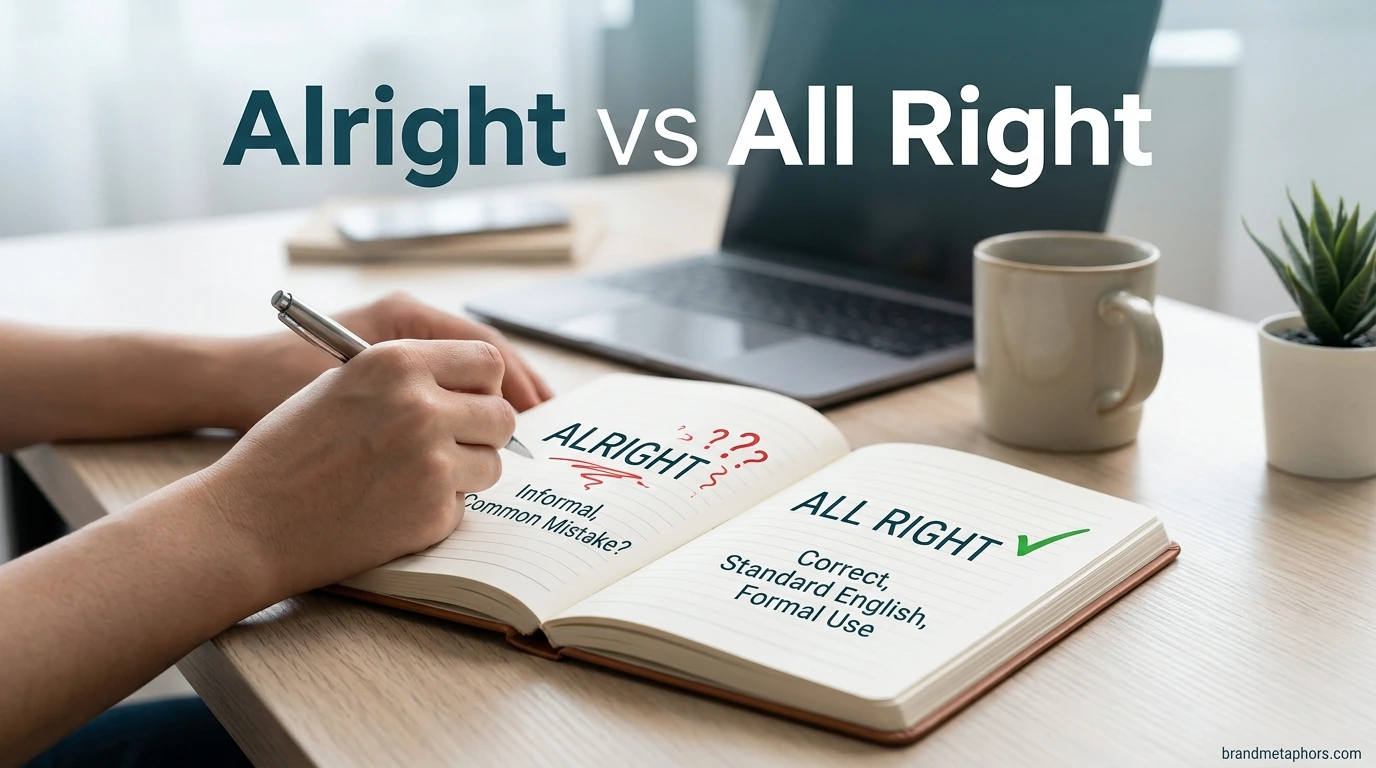
If you are writing for school, business, exams, or professional purposes, use all right.
The History of “All Right” and “Alright”
The phrase all right appeared first in English and has been used for centuries.
Later, writers began combining the two words into alright, much like:
- Already
- Altogether
- Always
Over time, “alright” became common in informal writing and speech. However, many grammar experts continued to prefer “all right.”
Today, many dictionaries recognize both forms, but most style guides still recommend using all right in formal situations.
Why Do Writers Get Confused?
The confusion exists because English contains many words that evolved from two separate words.
Consider these examples:
Two WordsOne WordAll togetherAltogetherAny oneAnyoneEvery dayEverydayAll rightAlright
Because many two-word phrases eventually became single words, people naturally assume that “alright” is the standard spelling.
However, grammar authorities have not fully accepted it for formal writing.
When to Use “All Right”
Use all right when writing:
- Academic essays
- School assignments
- Research papers
- Professional emails
- Business reports
- Formal letters
- Official documents
Examples
- Are you feeling all right today?
- The project is all right for submission.
- Everything will be all right.
- The teacher said my essay was all right.
- Is your brother all right after the accident?
Formal Writing Example
“The results were all right, but further research is needed.”
This sentence looks professional and follows traditional grammar standards.
When to Use “Alright”

Use alright mainly in:
- Informal writing
- Casual messages
- Text conversations
- Creative writing
- Fiction dialogue
- Personal journals
Examples
- Alright, let’s begin.
- The movie was alright.
- Alright, I understand your point.
- Things are alright now.
- Alright, see you tomorrow.
Informal Tone Example
“Alright, guys, let’s start the game.”
This sounds natural and conversational.
Tone Differences Between the Two Forms
Although the meanings are the same, the tone can feel slightly different.
ExpressionToneAll RightFormal, traditionalAlrightCasual, relaxed
Example Comparison
Formal:
“The patient is all right and recovering well.”
Informal:
“The patient is alright now.”
The message remains the same, but the style changes.
Sentence Examples for Better Understanding
Using “All Right”
- Everything is all right now.
- The students are all right after the trip.
- Your answer is all right.
- She felt all right after resting.
- The report looks all right.
Using “Alright”
- Alright, let’s move forward.
- The food was alright.
- I’m alright today.
- Alright, I will help you.
- The performance was alright.
Comparison Examples
All RightAlrightAre you all right?Are you alright?Everything is all right.Everything is alright.That’s all right with me.That’s alright with me.
Common Mistakes Writers Make
Many learners make avoidable mistakes when using these expressions.
Mistake 1: Using “Alright” in Academic Writing
❌ The experiment was alright.
✅ The experiment was all right.
Mistake 2: Assuming One Meaning Is Different
❌ All right means okay, but alright means excellent.
✅ Both generally mean okay or acceptable.
Mistake 3: Using Them Without Considering Audience
Informal audience:
✔ Alright, let’s go.
Formal audience:
✔ All right, let’s proceed.
Using These Expressions in Creative Writing
Creative writing often values natural dialogue and realistic speech.
Dialogue Example
“Alright,” Jake said, “I’ll give it another try.”
This sounds natural because people frequently say “alright” in conversation.
Narrative Example
Everything seemed all right until the storm arrived.
The traditional form fits well in narration.
Why This Matters
Good creative writing balances:
- Vocabulary enhancement
- Descriptive language
- Realistic dialogue
- Literary devices
- Tone consistency
Choosing the appropriate form helps create the desired effect.
Figurative Language and These Expressions
Figurative language makes writing vivid and memorable. While “all right” and “alright” are not figurative expressions themselves, they often appear in figurative contexts.
Simile Examples
- She felt as all right as a bird returning home.
- He looked as alright as someone who had never worried.
Metaphor Examples
- Hope was an all-right bridge across fear.
- Her smile was an alright shelter during difficult times.
Poetic Expression Examples
- After the rain, everything felt all right again.
- The sunrise whispered that life would be alright.
These examples demonstrate how descriptive language and poetic expression can strengthen writing.
Literary Devices and Usage

Writers often combine these expressions with literary devices.
Imagery
“Everything was all right beneath the golden evening sky.”
Personification
“The morning breeze assured her that all was right.”
Hyperbole
“I worried a million times before learning everything was all right.”
Symbolism
The phrase “all right” may symbolize:
- Safety
- Relief
- Stability
- Peace
Using literary devices can improve reader engagement and writing quality.
Idiom Meaning and Related Expressions
Several English expressions have similar meanings.
Similar Expressions
- Okay
- Fine
- Acceptable
- Satisfactory
- Good
- Safe
- Well
Example Sentences
- Everything is okay now.
- Everything is fine now.
- Everything is all right now.
These expressions often serve similar communicative purposes.
Writing Skills Tips for Students and English Learners
Improving grammar requires practice and awareness.
Helpful Strategies
Know Your Audience
Ask yourself:
- Is this formal writing?
- Is this informal writing?
Formal → Use all right
Informal → Either may work
Read Professional Writing
Observe how newspapers, textbooks, and academic publications use all right.
Practice Editing
Review your writing before submitting it.
Replace informal forms when necessary.
Build Vocabulary
Vocabulary enhancement improves clarity and confidence.
Examples:
Simple WordBetter AlternativeOkayAcceptableGoodSatisfactoryFineSuitableNicePleasant
Practice Exercises
Exercise 1: Choose the Correct Option
- Everything is _____ now.
- a) alright
- b) all right
- _____, let’s begin the meeting.
- a) Alright
- b) All right
- The report looks _____ for submission.
- a) all right
- b) alright
Answers
- b) all right
- a) Alright
- a) all right
Exercise 2: Correct the Sentence
- My essay is alright for academic submission.
- Everything was alright according to the official report.
Suggested Corrections
- My essay is all right for academic submission.
- Everything was all right according to the official report.
Exercise 3: Create Your Own Sentences
Write:
- Two sentences using all right.
- Two sentences using alright.
- One sentence containing a simile.
- One sentence containing a metaphor.
This practice strengthens grammar and creative writing skills.
When Should You Avoid Each Form?

Avoid “Alright” When
- Writing essays
- Taking exams
- Preparing reports
- Creating professional documents
- Writing formal emails
Avoid Casual Use of “All Right” When
You may not need such formality in:
- Text messages
- Chat conversations
- Fiction dialogue
- Personal notes
Always consider context and audience.
Frequently Asked Questions (FAQs)
1. Is “alright” grammatically correct?
Many modern dictionaries recognize it, but many editors and style guides still prefer “all right,” especially in formal writing.
2. Which spelling should students use?
Students should generally use all right in assignments, essays, and examinations.
3. Do both expressions have the same meaning?
Yes. Both usually mean okay, fine, acceptable, or satisfactory.
4. Can I use “alright” in fiction?
Yes. It often appears in dialogue and informal creative writing.
5. Which form is safer for professional writing?
The safest choice is all right because it is widely accepted by grammar experts and style guides.
Concluion
Understanding the difference between all right and alright can improve grammar, writing skills, and overall communication. While both forms generally share the same meaning, all right remains the preferred choice for formal writing, academic work, business communication, and professional documents. Meanwhile, alright is common in casual conversations and creative writing.
For students, writers, and English learners, the easiest rule is simple: when in doubt, use all right. It is widely accepted, editor-friendly, and suitable for nearly every situation. By mastering small distinctions like this one, you strengthen your vocabulary, improve descriptive language, enhance creative writing, and become a more confident communicator.