
Introduction
Good writing is more than putting words together. It is about choosing the right words, using correct spelling, and expressing ideas clearly. Whether you are a student, writer, or English learner, understanding spelling differences can improve your writing skills and communication.
At the same time, strong writing often uses figurative language, descriptive language, literary devices, similes, metaphors, and poetic expression to make ideas more engaging. However, before mastering creative writing techniques, it is important to understand basic language rules, including correct spelling and word formation.
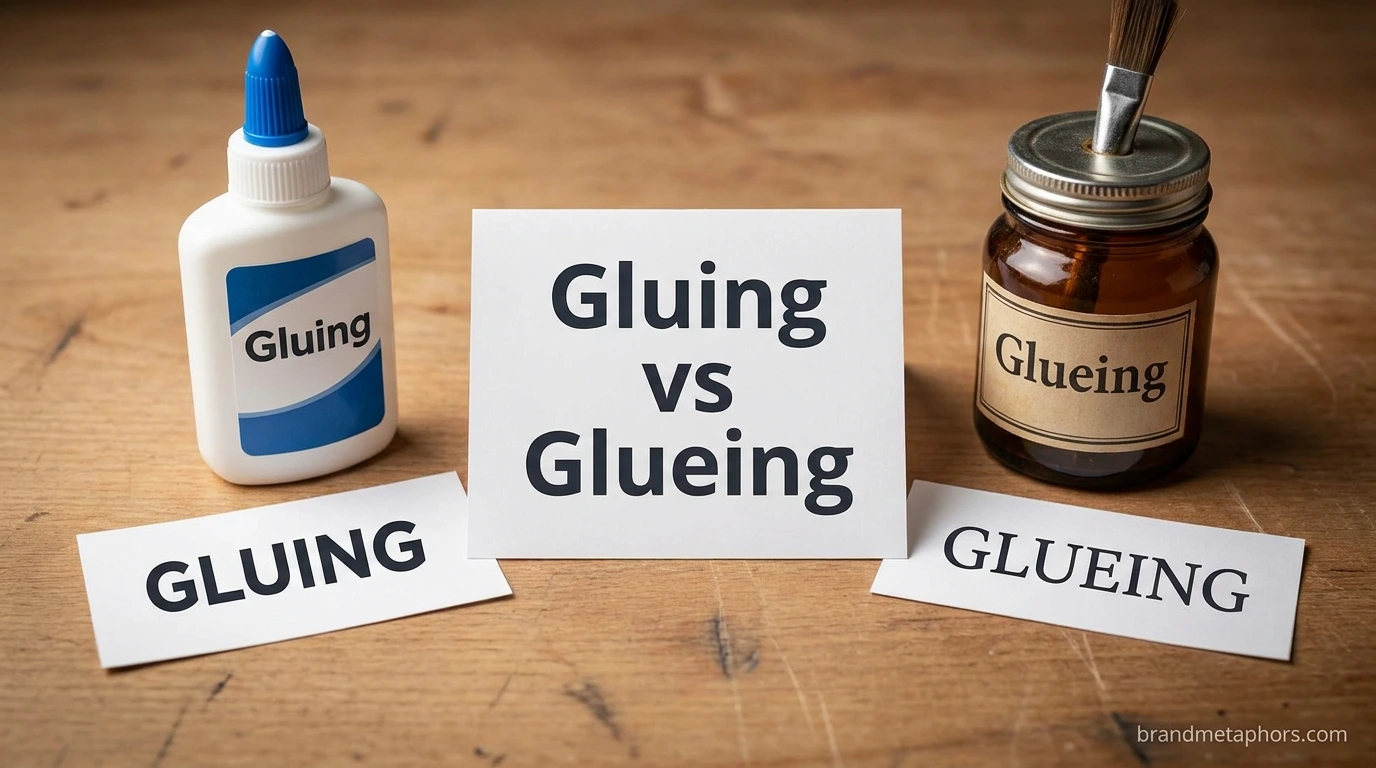
One common question many learners ask is about gluing vs glueing. Which spelling is correct? Why do some people use both forms? Is one accepted in modern English while the other is not?
This detailed guide explains the difference, usage rules, examples, common mistakes, exercises, and practical tips for improving vocabulary enhancement and writing accuracy.
Understanding the Word “Glue”
The word glue can function as both a noun and a verb.
As a Noun
Glue is a sticky substance used to join materials together.
Examples:
- I need some glue to fix my broken model.
- The teacher gave students glue for the art project.
As a Verb
Glue means to attach or stick things together.
Examples:
- Please glue these papers together.
- She glued the photographs into her scrapbook.
When changing the verb into its present participle or continuous form, many writers become confused about the correct spelling.
What Is the Correct Spelling?
The standard and widely accepted spelling is:
✅ Gluing
The alternative spelling:
⚠️ Glueing
is considered uncommon and largely outdated in modern English.
Quick Comparison Table
FormStatusUsageGluingCorrect and preferredModern EnglishGlueingRare and older variantOccasionally seen in older texts
Most dictionaries, style guides, schools, and professional writers recommend using gluing.
Why Is “Gluing” Preferred?
English has spelling rules for words ending in silent “e.”
When a verb ends with a silent “e” and takes “-ing,” the final “e” is usually dropped.
Examples
Base Verb+ ing FormMakeMakingWriteWritingBakeBakingSmileSmilingGlueGluing
Following this rule, “glue” becomes gluing, not “glueing.”
This spelling looks cleaner and follows standard English conventions.
Why Does “Glueing” Sometimes Appear?
The spelling “glueing” developed because some writers wanted to preserve the original spelling of the word “glue.”
Historically, both forms appeared in printed materials. However, language evolves, and modern dictionaries gradually standardized gluing as the preferred version.
You may still encounter “glueing” in:
- Older books
- Historical documents
- Archived newspapers
- Personal writing styles
Even though it occasionally appears, most teachers and editors recommend avoiding it.
Examples of Correct Usage
Here are common sentence examples using the correct spelling.
Everyday Situations
- I am gluing the broken pieces together.
- She spent the afternoon gluing decorations onto the poster.
- They are gluing wood panels for the project.
- The child enjoys gluing colorful shapes onto paper.
- We are gluing labels onto the boxes.
Academic Writing
- Researchers were gluing components during the experiment.
- Students practiced gluing materials for their science models.
Professional Writing
- Workers are gluing parts together in the factory.
- The technician is gluing the protective layer into place.
Common Mistakes Writers Make
Many learners make mistakes because English spelling rules can be confusing.
Mistake 1: Using “Glueing” in Formal Writing
❌ The students were glueing the artwork.
✅ The students were gluing the artwork.
Mistake 2: Keeping the Silent E
Some writers think the original word must stay unchanged.
❌ glue + ing = glueing
✅ glue + ing = gluing
Mistake 3: Inconsistent Usage
Using different spellings in the same document can confuse readers.
❌ He was gluing the model while others were glueing posters.
✅ He was gluing the model while others were gluing posters.
Word Formation Rules You Should Know
Understanding word formation improves writing skills and vocabulary enhancement.
Rule 1: Drop the Silent E
Most verbs ending in silent “e” drop the “e” before adding “-ing.”
VerbPresent ParticipleDriveDrivingWriteWritingSmileSmilingBakeBakingGlueGluing
Rule 2: Keep E When Needed for Pronunciation
Sometimes the “e” remains to avoid confusion.
Examples include:
- Dye → Dyeing
- Singe → Singeing
These words keep the “e” because removing it would change pronunciation or meaning.
Creative Writing and Descriptive Language Examples
Understanding spelling is important, but strong writers also use descriptive language and literary devices.
Descriptive Example
Instead of:
- The child was gluing paper.
Try:
- The child was carefully gluing bright pieces of paper onto the colorful poster.
The second sentence creates a clearer image.
Poetic Expression
- She spent the evening gluing memories into a scrapbook of dreams.
This sentence uses poetic expression to create emotion.
Creative Writing Example
- The artist sat quietly, gluing fragments of color together until a masterpiece emerged.
Creative descriptions make writing more engaging.
Figurative Language Using the Idea of Glue
The concept of glue is often used in figurative language.
Meaning
Instead of referring to actual adhesive, glue can symbolize connection, unity, or relationships.
Examples
- Trust is the glue that holds a team together.
- Love is the glue of a happy family.
- Communication acts as the glue between employees and management.
These examples use figurative language rather than literal meaning.
Metaphor Examples
A metaphor directly compares two things without using “like” or “as.”
Examples
- Friendship is the glue of society.
- Trust is the glue holding their relationship together.
- Teamwork is the glue that connects successful organizations.
These metaphor examples show how abstract ideas can be described more vividly.
Simile Examples
A simile compares things using “like” or “as.”
Examples
- The pages stuck together like they were covered in glue.
- The children gathered together like pieces glued into a puzzle.
- The group remained united like photographs glued into an album.
Simile examples help readers visualize comparisons more clearly.
Literary Devices Related to Connection and Unity

Writers often use literary devices to express ideas about bonding, attachment, and relationships.
Metaphor
- Trust is the glue of friendship.
Simile
- They stayed together like glued puzzle pieces.
Symbolism
Glue may symbolize:
- Unity
- Loyalty
- Family bonds
- Friendship
- Cooperation
Personification
- The glue stubbornly refused to let the pages separate.
These literary devices strengthen creative writing and storytelling.
When to Use the Word “Gluing”
Use “gluing” when describing an action that is happening now or continuously.
Present Continuous
- She is gluing the poster.
Past Continuous
- They were gluing decorations all afternoon.
Future Continuous
- We will be gluing the pieces tomorrow.
Educational Context
- Students are gluing shapes during art class.
Workplace Context
- Employees are gluing labels onto products.
When to Avoid Certain Uses
Avoid using the rare spelling “glueing” in:
- School assignments
- Academic papers
- Business writing
- Professional emails
- Published articles
- Examination answers
Using the standard spelling demonstrates stronger language knowledge.
Practice Exercises
Exercise 1: Choose the Correct Form
- She is ______ the pictures into a notebook.
- a) glueing
- b) gluing
- They were ______ cardboard pieces together.
- a) gluing
- b) glueing
- We will be ______ decorations tomorrow.
- a) gluing
- b) glueing
Answers
- b) gluing
- a) gluing
- a) gluing
Exercise 2: Correct the Sentence
- The students are glueing posters.
- He spent hours glueing model parts.
- We were glueing photographs into albums.
Corrected Versions
- The students are gluing posters.
- He spent hours gluing model parts.
- We were gluing photographs into albums.
Exercise 3: Create Your Own Sentences
Write one sentence for each:
- School project
- Art activity
- Family scrapbook
- Science experiment
- Creative writing scene
This exercise helps improve vocabulary enhancement and sentence-building skills.
Benefits of Learning Correct Spelling

Knowing the correct spelling offers many advantages.
Better Academic Performance
Teachers expect accurate spelling.
Improved Writing Skills
Correct spelling increases clarity and professionalism.
Stronger Communication
Readers understand your message more easily.
Vocabulary Enhancement
Learning spelling patterns helps you understand other English words.
Greater Confidence
Writers who understand language rules write with more confidence.
Frequently Asked Questions (FAQs)
1. Is “glueing” wrong?
It is not completely wrong, but it is considered uncommon and outdated. Modern English strongly prefers “gluing.”
2. Which spelling should students use?
Students should use gluing in assignments, exams, and academic writing.
3. Why is the “e” removed?
English spelling rules usually drop a silent “e” before adding “-ing.”
4. Do dictionaries accept both spellings?
Some dictionaries may mention “glueing” as a variant, but “gluing” is the standard form.
5. Can I use “glueing” in creative writing?
You can, but readers and editors generally expect the modern spelling “gluing.”
Conclusion
Understanding the difference between gluing and glueing helps writers avoid common spelling mistakes and improve communication. While both forms have appeared historically, gluing is the accepted modern spelling and should be used in academic, professional, and everyday writing.
Learning these spelling patterns strengthens writing skills, improves vocabulary enhancement, and builds confidence in English usage. Combined with figurative language, descriptive language, simile examples, metaphor examples, literary devices, and creative writing techniques, accurate spelling allows writers to express ideas clearly and effectively.
The simple rule is easy to remember: when adding -ing to glue, drop the silent e and write gluing. Following this rule will keep your writing accurate, professional, and easy to understand.