
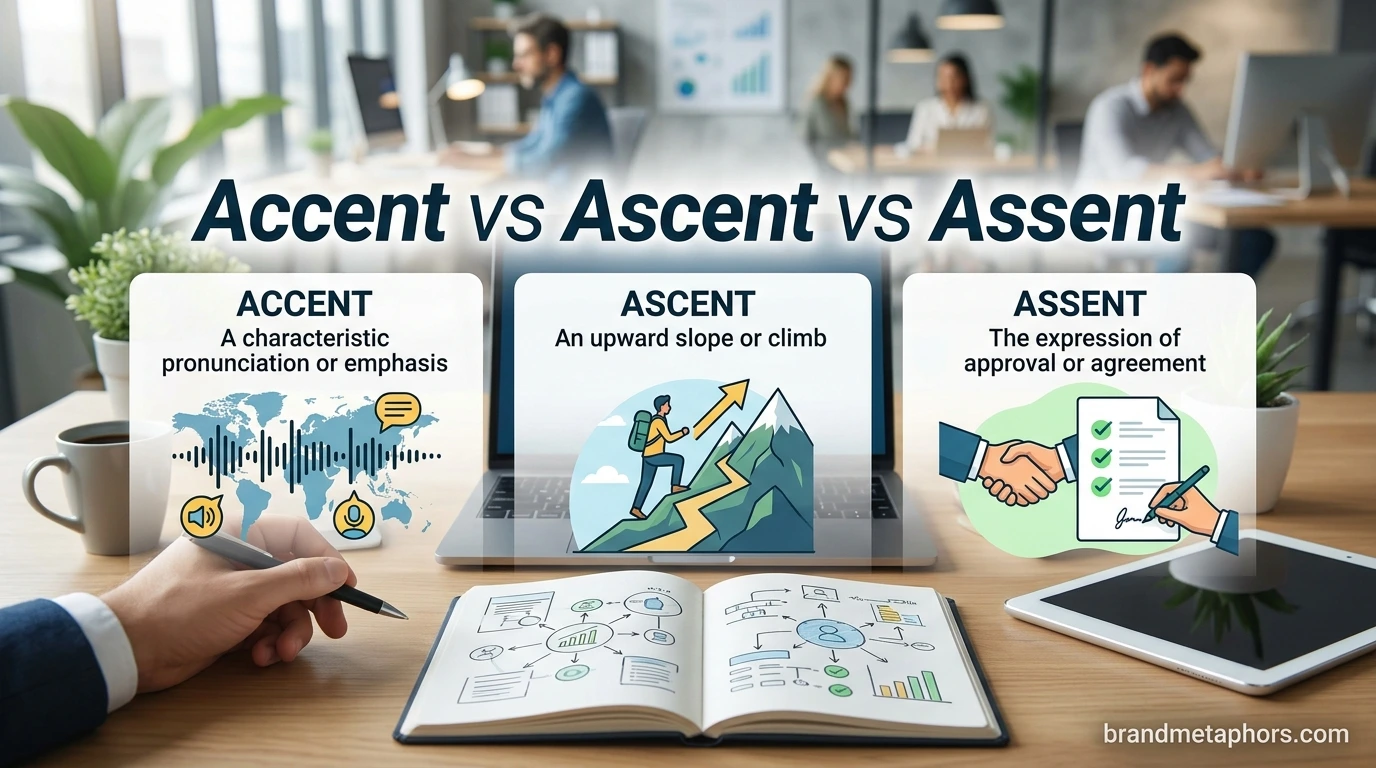
English contains many words that sound alike but have very different meanings. These words are called homophones, and they often confuse students, writers, and English learners. Learning the difference between similar-sounding words improves vocabulary, writing skills, reading comprehension, and communication.
Strong writing depends on choosing the right words. Whether you are creating essays, stories, poems, speeches, or creative writing pieces, using precise language helps readers understand your message clearly. It also improves descriptive language, poetic expression, and overall writing quality.
In this guide, you will learn the meanings, uses, examples, common mistakes, comparison tables, exercises, and practical tips related to accent vs ascent vs assent in simple and easy-to-understand language.
Why Word Choice Matters in Writing
Good writers pay attention to word choice because one incorrect word can completely change a sentence’s meaning.
Benefits of using the correct word include:
- Better communication
- Improved writing skills
- Vocabulary enhancement
- Stronger creative writing
- More professional essays and reports
- Clearer poetic expression
- Better understanding of literary devices
For example:
- Incorrect: She gave her ascent to the proposal.
- Correct: She gave her assent to the proposal.
Even though the words sound similar, only one fits the sentence.
Understanding Homophones
Homophones are words that sound alike but have different meanings and spellings.
Examples:
Word PairMeaning DifferenceTheir / TherePossession vs PlaceRight / WriteDirection vs ComposeFlower / FlourPlant vs Baking IngredientAccent / Ascent / AssentPronunciation vs Climb vs Agreement
Because these words share similar pronunciation, writers must understand their meanings before using them.
What Does “Accent” Mean?
The word accent usually refers to a way of pronouncing words that is influenced by a region, country, or social group.
Definition
An accent is a distinctive manner of speech or pronunciation.
Common Uses
- Language learning
- Speaking and communication
- Linguistics
- Public speaking
- Drama and acting
Sentence Examples
- She speaks English with a French accent.
- His British accent is easy to recognize.
- The actor learned a Scottish accent for the movie.
- Her accent reveals where she grew up.
- The teacher explained different English accents.
Accent as a Verb
Accent can also mean to emphasize something.
Examples:
- The designer used red curtains to accent the room.
- Her speech accented the importance of education.
Related Vocabulary
- Pronunciation
- Dialect
- Speech pattern
- Intonation
- Communication
What Does “Ascent” Mean?
The word ascent refers to the act of moving upward or climbing.
Definition
Ascent means a rise, climb, or upward movement.
Common Uses
- Mountain climbing
- Travel
- Aviation
- Personal growth
- Success journeys
Sentence Examples
- The ascent to the mountain peak was difficult.
- Their ascent took six hours.
- The airplane began its ascent shortly after takeoff.
- The climbers celebrated a successful ascent.
- Her ascent to leadership inspired many people.
Literal and Figurative Meanings
Literal Meaning
Actual upward movement.
Example:
- The ascent of the staircase was steep.
Figurative Meaning
Progress, improvement, or advancement.
Example:
- His ascent in the business world was impressive.
Related Vocabulary
- Climb
- Rise
- Growth
- Elevation
- Advancement
What Does “Assent” Mean?
The word assent means agreement or approval.
Definition
Assent is the expression of approval, acceptance, or consent.
Common Uses
- Formal communication
- Legal writing
- Business meetings
- Academic discussions
- Government documents
Sentence Examples
- The committee gave its assent to the proposal.
- She nodded in assent.
- The manager expressed assent during the meeting.
- Everyone gave assent to the new rules.
- The plan moved forward after receiving assent.
Assent as a Verb
Examples:
- I assent to your suggestion.
- The board assented to the decision.
Related Vocabulary
- Agreement
- Approval
- Consent
- Acceptance
- Permission
Quick Comparison Table
WordMeaningPart of SpeechExampleAccentWay of speaking or pronunciationNoun/VerbShe has a Spanish accent.AscentUpward climb or riseNounThe ascent was difficult.AssentAgreement or approvalNoun/VerbThey gave assent to the proposal.
Easy Memory Tricks
Remembering these words becomes easier with simple tricks.
Accent
Think of speaking and pronunciation.
A person speaks with an accent.
Ascent
Contains the word idea of climbing upward.
A mountain ascent involves climbing.
Assent
Think of saying “yes.”
Assent means agreement or approval.
Memory Table
WordMemory TrickAccentSpeech and pronunciationAscentClimbing upwardAssentSaying yes or agreeing
Sentence Examples for Comparison
Looking at similar sentences helps learners understand the differences.
Accent
- Her accent sounds Australian.
- The actor perfected his accent.
Ascent
- Their ascent up the hill was exhausting.
- The helicopter started its ascent.
Assent
- The board gave assent immediately.
- She expressed assent with a smile.
Side-by-Side Examples
SentenceCorrect WordShe speaks with a strong regional _____.AccentThe climbers completed the _____ safely.AscentThe committee gave its _____.AssentHis English _____ improved over time.AccentThe plane began its _____.AscentEveryone showed _____ to the proposal.Assent
Using These Words in Creative Writing

Creative writing often requires precise vocabulary. Choosing the correct word improves storytelling and descriptive language.
Using Accent
Example:
The old sailor’s accent carried memories of distant oceans.
This creates character depth and realism.
Using Ascent
Example:
Their ascent through the snowy mountains tested their courage.
This creates imagery and adventure.
Using Assent
Example:
The king’s silent assent changed the kingdom’s future.
This adds drama and authority.
Connection to Figurative Language and Literary Devices
Although these words are not figurative language themselves, they often appear in literary and creative works.
Figurative Language
Figurative language uses words imaginatively rather than literally.
Examples include:
- Metaphors
- Similes
- Personification
- Hyperbole
Metaphor Examples with Ascent
- Her career was an ascent toward greatness.
- Knowledge is an ascent from darkness to light.
Simile Examples
- His rise was like an ascent up a steep mountain.
- Her approval came as quietly as a whisper of assent.
Poetic Expression
Writers often use ascent symbolically.
Example:
Every dream begins its ascent toward reality.
This creates emotional and inspirational meaning.
Tone and Context: Choosing the Right Word
The tone of a sentence influences which word fits best.
ContextBest WordPronunciationAccentTravelAscentMountain climbingAscentAgreementAssentFormal approvalAssentSpeech and languageAccent
Examples
Informal Tone
- I love her accent.
Adventure Tone
- The ascent was thrilling.
Formal Tone
- The board granted its assent.
Understanding context helps avoid confusion.
Common Mistakes and How to Avoid Them
Many learners misuse these words because they sound similar.
Mistake 1
Incorrect:
- The mountain accent was difficult.
Correct:
- The mountain ascent was difficult.
Mistake 2
Incorrect:
- The committee gave its accent.
Correct:
- The committee gave its assent.
Mistake 3
Incorrect:
- His British assent is noticeable.
Correct:
- His British accent is noticeable.
Tips to Avoid Errors
- Check the sentence meaning.
- Identify whether it involves speech, climbing, or agreement.
- Use memory tricks.
- Proofread carefully.
- Practice writing example sentences.
When to Use and When to Avoid Each Word
Use Accent When
Discussing pronunciation
Talking about speech patterns
Referring to emphasis
Avoid when discussing climbing or approval.
Use Ascent When
Talking about climbing
Referring to upward movement
Describing progress or advancement
Avoid when discussing pronunciation or agreement.
Use Assent When
Expressing agreement
Giving approval
Discussing formal consent
Avoid when discussing language or climbing.
Practice Exercises
Exercise 1: Fill in the Blank
Choose the correct word.
- The pilot began the ______.
- She speaks with an Italian ______.
- The council gave its ______.
- Their mountain ______ took two days.
- His Scottish ______ is easy to recognize.
Answers
- Ascent
- Accent
- Assent
- Ascent
- Accent
Exercise 2: Identify the Correct Word
- Approval → ______
- Climb → ______
- Pronunciation → ______
- Consent → ______
- Rise → ______
Answers
- Assent
- Ascent
- Accent
- Assent
- Ascent
Exercise 3: Create Your Own Sentences
Write:
- Two sentences using accent
- Two sentences using ascent
- Two sentences using assent
This exercise strengthens vocabulary enhancement and writing skills.
Vocabulary Expansion: Related Words
In Related to Accent
- Pronunciation
- Dialect
- Intonation
- Speech
- Language
Related to Ascent
- Rise
- Climb
- Elevation
- Growth
- Advancement
Related to Assent
- Agreement
- Approval
- Consent
- Acceptance
- Permission
Learning related vocabulary improves both speaking and writing.
Real-Life Examples
School
- Students may have different accents depending on where they live.
Travel
- Hikers prepare carefully for a mountain ascent.
Business
- Projects often require official assent before implementation.
Literature
- Writers may use ascent as a metaphor for success.
- Characters can be identified through their accents.
- Kings, leaders, and councils often give assent to important decisions.
Frequently Asked Questions (FAQs)
1. Are accent, ascent, and assent pronounced the same?
Yes. They are commonly considered homophones because they sound nearly identical in standard English pronunciation.
2. What is the easiest way to remember the difference?
Remember:
- Accent = speech
- Ascent = climb
- Assent = agreement
3. Can assent be used as a verb?
Yes.
Example:
- I assent to the proposal.
4. Can ascent be used figuratively?
Yes.
Example:
- Her ascent to success was remarkable.
5. Can accent mean emphasis?
Yes.
Example:
- Bright colors accent the room beautifully.
Conclusion
Understanding the differences between accent, ascent, and assent is essential for clear communication and effective writing. While these words sound alike, their meanings are completely different. Accent relates to pronunciation and speech, ascent refers to climbing or upward progress, and assent means agreement or approval.
Mastering these commonly confused words improves vocabulary enhancement, writing skills, descriptive language, creative writing, and reading comprehension. By using memory tricks, practicing sentence examples, and paying attention to context, students and English learners can confidently choose the correct word every time. The more you practice, the more natural these distinctions become, helping you communicate with accuracy and confidence in both academic and everyday situations.