
Introduction
Good writing is more than putting words together. It is about creating clear images in the reader’s mind. This is where figurative language, descriptive language, and creative writing techniques become valuable. Writers use carefully chosen words to make characters, scenes, and emotions more vivid. Whether you are writing a story, poem, essay, or article, selecting the right word improves communication and strengthens your writing skills.
Many English learners and writers become confused when choosing between similar-looking words. One common example is bespeckled vs bespectacled. Although these words appear related, they have different meanings and are used in different contexts. Understanding the distinction helps improve vocabulary enhancement, descriptive writing, and language accuracy.
This guide explains the meanings, differences, examples, common mistakes, literary uses, and practical exercises to help you master these two words.
What Do Bespeckled and Bespectacled Mean?
Before comparing them, it is important to understand each word separately.
Bespeckled Meaning
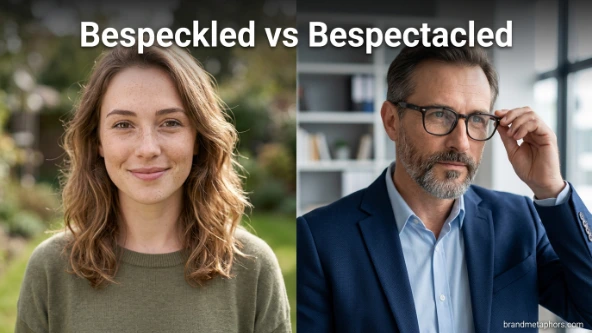
Bespeckled means covered with small spots, marks, specks, or dots.
The word comes from the noun speck, meaning a tiny mark or spot.
Examples:
- The leaves were bespeckled with rain droplets.
- Her dress was bespeckled with glitter.
- The night sky appeared bespeckled with stars.
The word often creates a visual image and is commonly used in descriptive language.
Bespectacled Meaning
Bespectacled means wearing spectacles or glasses.
The word comes from spectacles, an older term for eyeglasses.
Examples:
- The bespectacled professor entered the classroom.
- A bespectacled student sat in the front row.
- The detective interviewed a bespectacled witness.
This word is commonly used to describe a person’s appearance.
Quick Comparison Table
FeatureBespeckledBespectacledMeaningCovered with spots or specksWearing glassesRelated WordSpeckSpectaclesDescribesObjects, surfaces, naturePeopleVisual EffectDotted appearanceEyewear appearanceCommon ContextLiterature, nature writingCharacter descriptionsPart of SpeechAdjectiveAdjective
Origins and Word History
Understanding word origins helps build vocabulary and improve language learning.
Origin of Bespeckled
The prefix be- means “covered with” or “affected by.”
The root word speck means a tiny spot.
Therefore, bespeckled literally means:
Covered with small spots.
Origin of Bespectacled
The prefix be- combines with spectacles.
Therefore, bespectacled literally means:
Having spectacles or wearing glasses.
Although the words look similar, their roots are completely different.
When to Use Bespeckled
Use bespeckled when describing something covered with small marks, dots, particles, or spots.
Common Situations
- Nature descriptions
- Creative writing
- Poetry
- Artistic descriptions
- Landscape writing
Examples
- The mountain was bespeckled with patches of snow.
- The old wall was bespeckled with moss.
- The sky became bespeckled with countless stars.
- Her painting featured a bespeckled background.
- The butterfly had bespeckled wings.
Tone
Bespeckled often creates:
- Visual imagery
- Artistic expression
- Poetic expression
- Descriptive richness
When to Use Bespectacled

Use bespectacled when describing a person who wears glasses.
Common Situations
- Character descriptions
- Academic writing
- Fiction writing
- Journalism
- Biographical descriptions
Examples
- The bespectacled teacher explained the lesson.
- A bespectacled librarian greeted visitors.
- The bespectacled scientist presented her findings.
- Everyone recognized the bespectacled author.
- The bespectacled boy loved reading mystery novels.
Tone
Bespectacled often conveys:
- Formal description
- Character identity
- Professional appearance
- Detailed observation
Sentence Examples for Better Understanding
Bespeckled Sentences
- The garden path was bespeckled with colorful petals.
- The beach was bespeckled with seashells.
- Morning dew left the grass bespeckled with sparkling droplets.
- The fabric appeared bespeckled with silver threads.
- The night sky was bespeckled with bright stars.
Bespectacled Sentences
- The bespectacled lawyer reviewed the documents.
- A bespectacled woman stood near the entrance.
- The bespectacled student asked an intelligent question.
- The bespectacled writer signed copies of his book.
- The bespectacled doctor explained the treatment carefully.
Bespeckled and Bespectacled in Creative Writing
Creative writers use descriptive words to create memorable images.
Using Bespeckled
Example:
“The meadow stretched endlessly, bespeckled with yellow wildflowers that danced in the breeze.”
This sentence creates vivid imagery.
Using Bespectacled
Example:
“The bespectacled detective studied the clue carefully before speaking.”
This helps readers visualize the character.
Writers often combine such adjectives with literary devices to strengthen storytelling.
Figurative Language and Literary Devices
While these words are usually literal, they can also appear in figurative language.
Metaphor Examples
A metaphor compares things directly.
Examples:
- The city was a bespeckled canvas of lights.
- The classroom was a bespectacled kingdom of scholars.
Simile Examples
A simile uses “like” or “as.”
Examples:
- The stars were scattered like a bespeckled blanket.
- He looked as serious as a bespectacled professor.
Imagery
Imagery appeals to the senses.
Examples:
- A bespeckled field of flowers stretched toward the horizon.
- The bespectacled historian flipped through ancient records.
Symbolism
Sometimes glasses symbolize:
- Intelligence
- Knowledge
- Wisdom
Thus a bespectacled character may symbolize learning or expertise.
Comparison Examples in Context
The difference becomes clearer when viewed side by side.
IncorrectCorrectThe bespectacled sky glittered with stars.The bespeckled sky glittered with stars.The bespeckled professor entered the room.The bespectacled professor entered the room.The bespectacled butterfly had dotted wings.The bespeckled butterfly had dotted wings.The bespeckled student adjusted his glasses.The bespectacled student adjusted his glasses.
These examples show how meaning changes completely depending on the word used.
Common Mistakes and How to Avoid Them
Mistake 1: Confusing Specks with Spectacles
Many learners notice the similar spelling and assume the words are interchangeable.
Remember:
- Speck = tiny spot
- Spectacles = glasses
Mistake 2: Using Bespeckled for People Wearing Glasses
Incorrect:
- The bespeckled teacher entered the room.
Correct:
- The bespectacled teacher entered the room.
Mistake 3: Using Bespectacled for Objects
Incorrect:
- The bespectacled sky was full of stars.
Correct:
- The bespeckled sky was full of stars.
Memory Trick
Think:
Speck = Spot
Spectacles = Glasses
This simple association prevents confusion.
When to Avoid These Words
Although useful, these words are not always the best choice.
Avoid Bespeckled When
- Simple language is preferred.
- Readers may not know the word.
- Clarity is more important than style.
Alternative words:
- Spotted
- Dotted
- Speckled
- Marked
Avoid Bespectacled When
- Informal writing is required.
- Simpler wording works better.
Alternative phrases:
- Wearing glasses
- Glasses-wearing
- In glasses
Choose words based on audience and writing purpose.
Vocabulary Enhancement and Related Words
Expanding vocabulary improves communication and writing quality.
Words Related to Bespeckled
- Speckled
- Dotted
- Spotted
- Flecked
- Sprinkled
- Marked
- Mottled
Words Related to Bespectacled
- Glasses-wearing
- Eyeglass-wearing
- Scholarly-looking
- Intellectual
- Academic-looking
Learning related terms helps writers vary sentence structure and avoid repetition.
Practice Exercises
Exercise 1: Fill in the Blank
Choose the correct word.
- The night sky was ________ with stars.
- The ________ scientist presented new research.
- The field was ________ with flowers.
- A ________ librarian greeted visitors.
- The painting was ________ with colorful dots.
Answers
- Bespeckled
- Bespectacled
- Bespeckled
- Bespectacled
- Bespeckled
Exercise 2: Correct the Sentence
- The bespectacled butterfly landed on a flower.
- The bespeckled teacher adjusted her glasses.
- The bespectacled sky glowed at night.
Answers
- The bespeckled butterfly landed on a flower.
- The bespectacled teacher adjusted her glasses.
- The bespeckled sky glowed at night.
Exercise 3: Create Your Own Sentences
Write:
- Two sentences using bespeckled.
- Two sentences using bespectacled.
- One metaphor using either word.
- One simile using either word.
This exercise strengthens writing skills and vocabulary retention.
Tone and Style Considerations
Formal Writing
Best choice:
- Bespectacled
Example:
“The bespectacled researcher explained the findings.”
Literary Writing
Best choice:
- Bespeckled
Example:
“The valley lay bespeckled with wildflowers.”
Poetry
Both words can work effectively depending on context.
Examples:
- Bespeckled horizons shimmered at dawn.
- The bespectacled sage shared ancient wisdom.
Using precise adjectives improves tone and reader engagement.
Why Understanding Word Differences Matters
Learning subtle vocabulary distinctions helps writers:
- Communicate accurately
- Improve grammar awareness
- Enhance descriptive language
- Strengthen reading comprehension
- Build academic writing skills
- Improve creative writing quality
Even small vocabulary differences can greatly affect meaning.
Frequently Asked Questions (FAQs)
1. What is the main difference between bespeckled and bespectacled?
Bespeckled means covered with spots or specks, while bespectacled means wearing glasses.
2. Can bespeckled describe a person?
Yes, but only if the person is covered with spots, marks, or specks. It does not mean wearing glasses.
3. Is bespectacled an old-fashioned word?
It is somewhat formal and traditional but remains widely understood and used in modern English.
4. Which word is more common in literature?
Both appear in literature, but bespeckled is often used for scenery and imagery, while bespectacled is used for character descriptions.
5. Can these words be used in poetry?
Yes. Their strong visual quality makes them useful in poetic expression and descriptive writing.
Conclusion
Although bespeckled and bespectacled look similar, they describe completely different things. Bespeckled refers to something covered with spots, specks, or tiny marks, while bespectacled refers to a person wearing glasses. Understanding this distinction improves vocabulary enhancement, writing accuracy, and communication skills.
Writers can use bespeckled to create vivid imagery in nature descriptions, poetry, and creative writing. Bespectacled works best when describing people and character appearances. By learning their meanings, practicing sentence examples, avoiding common mistakes, and applying literary devices such as metaphors and similes, students and English learners can strengthen their writing skills and use these words with confidence.