
H2: Introduction – Why Language Precision and Figurative Expression Matter
Language is more than just words; it is a powerful tool for communication, creativity, and expression. When we learn English, even small differences in words can completely change meaning. That is why understanding vocabulary deeply is important for students, writers, and English learners.
In writing and speech, figurative language, creative writing, and descriptive language help us express emotions clearly. For example, metaphors, similes, and idioms make writing more engaging and expressive. Instead of saying “I am very tired,” a writer might say “I feel like a drained battery.” This makes communication more vivid and interesting.
However, strong writing is not only about creativity. It is also about accuracy. Confusing similar-looking words can lead to misunderstandings. One of the most common confusions in English is between two words that look almost the same but have completely different meanings in real life: impatient vs inpatient.
Understanding such differences improves writing skills, vocabulary enhancement, and overall communication clarity. Let’s explore both words in detail.
H2: What Does “Impatient” Mean? (Definition + Explanation)
The word impatient describes a feeling or personality trait. A person is impatient when they cannot wait calmly for something. They want things to happen quickly.
Simple Meaning:
- Not able to wait calmly
- Feeling irritated or restless during delay
Examples of Impatient in Sentences:
- She became impatient while waiting for the bus.
- The child was impatient for his birthday gift.
- I get impatient when the internet is slow.
Emotional Tone:
Impatient is often used to show frustration, eagerness, or urgency.
Common Situations:
- Waiting in queues
- Waiting for results
- Waiting for replies
Figurative Language Connection:
Writers often use similes and metaphors to describe impatience:
- “He was as impatient as a lion in a cage.”
- “Her patience was a thin thread ready to break.”
These expressions help in creative writing and make emotional description stronger.
H2: What Does “Inpatient” Mean? (Medical Context)
The word inpatient is completely different in meaning. It is not about emotions but about healthcare.
Simple Meaning:
A person who stays in a hospital for treatment.
Explanation:
An inpatient is someone admitted to a hospital and stays there for at least one night or longer for medical care.
Examples of Inpatient in Sentences:
- He was admitted as an inpatient after surgery.
- The hospital has a separate ward for inpatient care.
- Inpatient treatment is required for serious illnesses.
Medical Context:
- Hospitals
- Surgery recovery
- Serious medical conditions
Tone:
Formal and clinical, used in healthcare communication.
H2: Key Differences Between Impatient and Inpatient
FeatureImpatientInpatientMeaningUnable to wait calmlyHospitalized patientPart of SpeechAdjectiveNounContextEmotions, behaviorMedical, healthcareUsageEveryday EnglishMedical EnglishExampleShe is impatient in queuesHe is an inpatient at the hospital
This table clearly shows how different these two words are, even though they look similar.
H2: Word Origin and Why People Get Confused
Both words come from Latin roots and share similar spelling patterns, which causes confusion among learners.
- Impatient comes from “im-” (not) + “patient” (able to wait calmly)
- Inpatient comes from “in-” (inside) + “patient” (medical patient)
Why Confusion Happens:
- Similar spelling
- Same pronunciation rhythm
- Lack of context understanding
- Fast reading mistakes
English learners often mix them in writing, especially in exams or essays.
H2: Usage in Sentences (Practical Examples)

Impatient Examples (Daily Life):
- I feel impatient when I have to wait in traffic.
- She was impatient to open her gift.
- They became impatient during the long lecture.
Inpatient Examples (Medical Context):
- The doctor recommended inpatient treatment.
- The hospital has 200 inpatient beds.
- She worked in the inpatient department.
Comparison Sentences:
- Wrong: He is impatient in the hospital for treatment. ❌
- Correct: He is an inpatient in the hospital. ✔
- Wrong: She was an inpatient waiting for the bus. ❌
- Correct: She was impatient waiting for the bus. ✔
H2: Tone and Context – When to Use Each Word
Understanding tone is important in writing and speaking.
Impatient:
- Informal and emotional tone
- Used in daily conversation
- Expresses feelings
Inpatient:
- Formal and medical tone
- Used in healthcare and documentation
- Neutral and factual
Writing Tip:
Always check the context before using these words. Emotional context = impatient, medical context = inpatient.
H2: Common Mistakes Learners Make
English learners often make mistakes with these words.
Slip 1: Spelling Confusion
- Using “inpatient” instead of “impatient”
Mistake 2: Wrong Context
- Using inpatient in emotional situations
Mistake 3: Overgeneralization
- Thinking both words mean “waiting”
Correction Strategy:
- Remember: “impatient = emotion”
- Remember: “inpatient = hospital”
H2: Figurative Language, Idioms, and Creative Writing Use
Writers often use figurative language to describe impatience in a creative way.
Metaphors:
- “His patience was a ticking clock.”
- “Impatience burned inside her like fire.”
Similes:
- “She was as impatient as a child on Christmas morning.”
- “He waited like a storm ready to explode.”
Idioms Related to Impatience:
- “On edge”
- “Can’t sit still”
- “Lose patience”
Creative Writing Tip:
Using figurative expressions improves storytelling and makes characters feel real and emotional.
H2: Writing Skills and Vocabulary Enhancement Tips
To avoid confusion and improve English:
1. Learn Words in Context
Don’t memorize words alone. Learn sentences.
2. Practice Writing
Write daily sentences using both words.
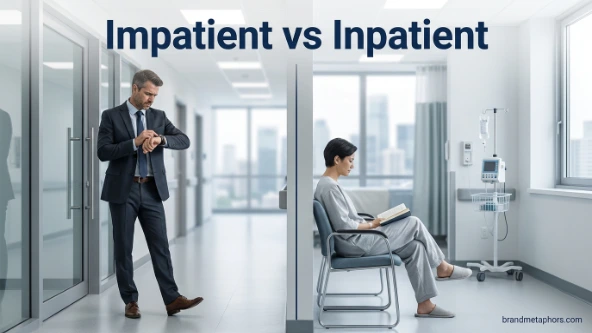
3. Use Visual Memory
- Impatient → emotional face
- Inpatient → hospital bed
4. Read More
Reading improves natural understanding.
5. Use Word Comparison Charts
Helps in quick revision.
H2: Practice Exercises (For Learners)
Exercise 1: Fill in the blanks
- She was ______ while waiting for the train.
- The patient is an ______ in the hospital.
- I feel ______ when I am late.
Drill 2: Correct the Sentence
- He is impatient in the hospital ward.
- The child is inpatient for the toy.
Exercise 3: Write Your Own Sentences
- Write 2 sentences using “impatient”
- Write 2 sentences using “inpatient”
Exercise 4: Identify Meaning
Which word is correct?
- Waiting in line → ______
- Hospital treatment → ______
H2: Quick Comparison Summary Table

CategoryImpatientInpatientEmotionYesNoMedical TermNoYesEveryday UseHighLowConfusion LevelHigh among learnersMediumExample FocusFeelingsHealthcare
H2: 5 Frequently Asked Questions (FAQs)
1. What is the main difference between impatient and inpatient?
Impatient is an emotion of not wanting to wait, while inpatient refers to a hospital patient receiving treatment.
2. Is inpatient used in daily conversation?
No, it is mostly used in medical or hospital contexts.
3. Can impatient be used in formal writing?
Yes, it can be used in essays, stories, and formal writing when describing emotions.
4. Why do learners confuse these words?
Because they have similar spelling and pronunciation patterns.
5. What is a simple trick to remember them?
Impatient = “I’m waiting impatiently” (emotion) Inpatient = “In hospital patient” (medical)
Conclusion
Understanding word differences is a key part of mastering English. Even small spelling changes can create completely different meanings. The difference between emotional vocabulary like impatience and medical terms like inpatient shows how important context is in communication.
By learning through examples, figurative language, comparison tables, and practice exercises, learners can improve writing skills, avoid mistakes, and enhance vocabulary confidence. Clear understanding of such words helps in both academic writing and real-life communication.
Strong language skills are built step by step, and mastering confusing word pairs is one of the most powerful steps toward fluency.