
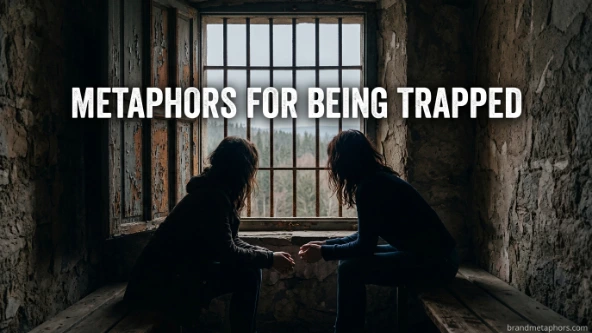
1. Metaphors for Being Trapped: Understanding the Concept and Emotional Landscape
What It Really Means to Feel Trapped
There are moments in life when space feels smaller than it is. Not because walls have moved, but because the mind has quietly folded inward. Being “trapped” is not always physical—it is often emotional, psychological, or symbolic. It can feel like standing in a room where every door looks locked, even if you haven’t tried the handle.
Metaphors help us translate that invisible pressure into something we can see, touch, or imagine. They turn emotional confinement into language: a cage, a maze, a deep well, a sinking ship. These images don’t just describe feelings—they validate them.
Understanding metaphors for being trapped matters because it gives shape to what often feels shapeless. When we name it, we begin to loosen it.
2. Metaphor: A Bird in a Cage
Meaning, Emotion, and Psychological Weight
A bird in a cage is one of the most powerful metaphors for being trapped. It suggests life, potential, and movement—restricted by invisible or visible bars.
The bird still has wings, but the sky is no longer reachable. That contrast is what makes this metaphor emotionally sharp.
Example Scenario
A talented artist working a job that limits creativity might say:
“I feel like a bird in a cage, singing only when I’m allowed.”
Alternative Expressions
- A soul behind bars
- Wings clipped mid-flight
- Freedom just out of reach
Sensory & Emotional Detail
You can almost hear the faint rustle of feathers against metal. The frustration is not silence—it is muted potential.
Mini Story
A young musician once played melodies on a locked apartment balcony. Neighbors said she sounded beautiful. But she later admitted, “I wasn’t performing—I was escaping.”
Interactive Prompt
Write about a moment when you felt “contained.” What would your cage look like? Metal? Glass? Invisible air?
3. Metaphor: Walking Through a Maze With No Exit
Confusion, Repetition, and Mental Exhaustion
A maze symbolizes confusion and repetition. Unlike a cage, which restricts movement, a maze allows movement—but without progress.
This metaphor captures emotional states where effort exists, but clarity does not.
Example Scenario
Someone trying to solve repeated life problems:
“Every decision feels like another turn in a maze that keeps looping back.”
Alternative Expressions
- Lost in a looping path
- Wandering without a map
- Turning corners into the same wall
Cultural Reference
In ancient Greek mythology, the Labyrinth of Crete trapped the Minotaur—but it also trapped those sent to destroy it. The maze becomes both prison and puzzle.
Sensory Detail
Echoing footsteps. Walls that feel identical. A growing doubt about direction.
Interactive Exercise
Draw a simple maze. Now place yourself inside it. Where would your “exit” emotionally be?
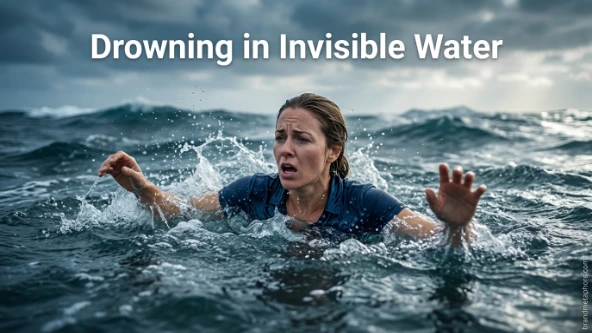
4. Metaphor: Drowning in Invisible Water
Emotional Overload and Silent Struggle
Being trapped can feel like drowning—not in visible water, but in emotions, responsibilities, or expectations.
You can breathe, yet you feel suffocated.
Example Scenario
A student overwhelmed by pressure:
“It’s like I’m drowning while everyone else is walking on dry land.”
Alternative Expressions
- Submerged in pressure
- Sinking under expectations
- Waves pulling me under
Emotional Texture
The silence is the worst part. No one sees the struggle because the water is invisible.
Mini Story
A worker once described checking emails at midnight as “breathing through water.” He wasn’t failing—he was slowly going under unnoticed.
Interactive Prompt
What is your “water”? Work, fear, expectations? Describe its weight and temperature.
5. Metaphor: A Locked Room Without a Key
Powerlessness and Lack of Control
A locked room suggests direct restriction. Unlike a maze or cage, this metaphor emphasizes helplessness and waiting.
Example Scenario
Someone stuck in a toxic relationship:
“It feels like I’m in a locked room, and I don’t know where the key was thrown.”
Alternative Expressions
- Sealed inside silence
- Locked behind decisions not mine
- Trapped in someone else’s structure
Sensory Detail
The sound of a turning handle that never opens. The frustration of doors that exist only visually.
Cultural Note
In literature, locked-room mysteries often symbolize the mind’s attempt to solve unsolvable emotional puzzles.
Exercise
Write a paragraph where the “key” is not physical but emotional—what would unlock your room?
6. Metaphor: A Spider in Its Own Web
Self-Made Traps and Emotional Complexity
Sometimes being trapped is not external—it is self-created. The spider in its web reflects patterns we build ourselves.
Example Scenario
A person overwhelmed by commitments:
“I’ve become a spider tangled in the web I thought would hold everything together.”
Alternative Expressions
- Caught in my own design
- Tangled in threads of my choices
- Architect of my own confinement
Sensory Detail
Sticky threads pulling in every direction. Movement makes it worse.
Mini Story
A freelancer took on too many projects, believing freedom meant saying yes to everything. Eventually, she realized she had woven a web too dense to escape.
Interactive Prompt
What habits or choices form your “web”?
7. Metaphor: A Train on Broken Tracks
Direction Without Destination
This metaphor reflects motion without control. You are moving, but not toward a safe or chosen place.
Example Scenario
Career uncertainty:
“I feel like a train running on broken tracks—fast, but not safe.”
Alternative Expressions
- Momentum without direction
- Racing toward nowhere
- Motion without mastery
Emotional Tone
Fear mixed with inevitability. You cannot stop easily, yet you cannot trust where you’re going.
Cultural Reference
Industrial-era literature often used trains as symbols of progress—but also loss of control in modern life.
Exercise
Write about where your “train” is heading emotionally. Is it speeding, stalling, or derailing?
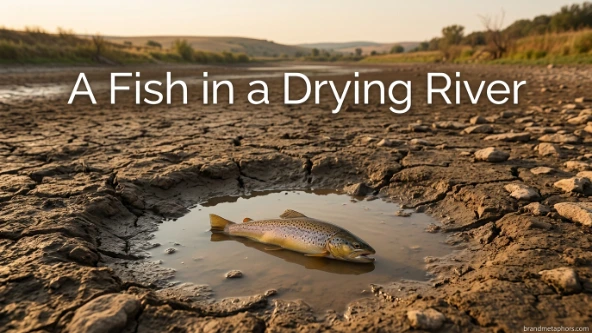
8. Metaphor: A Fish in a Drying River
Survival, Shrinking Options, and Time Pressure
This metaphor captures urgency. The environment is changing, and survival becomes harder with each moment.
Example Scenario
Financial stress:
“I feel like a fish in a river that’s slowly disappearing.”
Alternative Expressions
- Stranded in shrinking waters
- Losing space to breathe
- Time drying around me
Sensory Detail
Mud replacing water. Gills struggling. Heat replacing flow.
Mini Story
A farmer once described drought seasons as “watching the river forget how to exist.”
Interactive Prompt
What part of your life feels like it is “drying up”?
9. Metaphor: Wearing Shoes That Don’t Fit
Persistent Discomfort and Emotional Misalignment
This metaphor reflects long-term discomfort in identity, environment, or choices.
Example Scenario
A person in an unfulfilling job:
“Every day feels like wearing shoes two sizes too small.”
Alternative Expressions
- Walking in misfit expectations
- Painful steps forward
- Life that pinches at every move
Sensory Detail
Blisters, pressure, every step a reminder.
Exercise
List areas of life where you feel “too tight” or “too loose.”
10. Metaphor: A Theater With No Exit Door
Performance, Social Pressure, and Emotional Exhaustion
This metaphor reflects being stuck in roles you cannot step out of.
Example Scenario
Social expectations:
“It feels like I’m acting in a play where the stage has no exit.”
Alternative Expressions
- Living without a backstage
- Performing forever
- Roles that never end
Cultural Reference
In Shakespearean drama, life is often described as a stage—but here, the difference is escape. There is none.
Sensory Detail
Spotlights that never dim. Applause that becomes noise.
Interactive Exercise
What role are you playing right now that feels inescapable?
11. Bonus Tips: Using Metaphors for Being Trapped in Writing and Daily Life
Creative Expression and Emotional Clarity
Metaphors are not just literary tools—they are emotional translators.
Writing Tips
- Use physical imagery to express emotional states
- Combine two metaphors for depth (e.g., “a bird in a maze”)
- Avoid cliché repetition by personalizing images
Social Media Use
- Short captions: “Stuck in a maze of thoughts”
- Poetry-style posts: one metaphor per line
- Visual pairing: image + emotional metaphor
Daily Life Application
- Journaling: “Today I felt like…”
- Therapy or reflection writing
- Communication tool: explaining feelings to others
Creative Challenge
Write 5 different metaphors for your current mood without repeating objects.
Conclusion
Why These Metaphors Matter
Being trapped is not always about walls, locks, or barriers—it is often about perception, pressure, and emotion. Metaphors give these invisible experiences a voice.
Whether it is a bird in a cage, a maze without exit, or a fish in drying water, each image helps transform confusion into clarity.
And once something can be described, it becomes slightly more possible to understand—and eventually, to change.
FAQs
What are metaphors for being trapped?
They are symbolic expressions that describe emotional, psychological, or physical confinement using imagery like cages, mazes, or locked rooms.
Why are metaphors important for emotional expression?
They help people understand and communicate complex feelings that are otherwise difficult to explain directly.
Can metaphors help mental health?
Yes, they can support reflection, journaling, and communication, helping people process emotions more clearly.
What is the most common metaphor for feeling trapped?
“A bird in a cage” is one of the most widely used metaphors for restriction and lost freedom.
How can I create my own metaphors?
Think of your emotion, then compare it to something physical that shares its feeling, movement, or texture.