
Introduction: When Expectations Fall Like Glass in Slow Motion
There is a strange silence that follows disappointment. Not the loud kind of failure, but the quiet kind—the kind that arrives after anticipation has already built a small world inside your mind. Imagine standing at a train station, ticket in hand, watching the last train of hope slip away into the distance. The air feels heavier. Colors seem slightly duller. Even time, for a moment, feels uncertain.
Disappointment is one of the most universal human emotions, yet one of the hardest to express. That’s where metaphors come in. They give shape to what we struggle to name. They turn emotional fog into something visible—something we can understand, write about, and even share.
In writing, storytelling, journaling, or everyday speech, metaphors for disappointment help us communicate emotional depth without directly stating it. Instead of saying “I felt sad,” we can show it: “It felt like watching a candle go out in a windless room.”
In this article, we’ll explore rich, creative, and emotionally resonant metaphors for disappointment, along with examples, meanings, storytelling moments, and practical exercises to help you use them naturally in writing and life.
1. Disappointment as a Deflated Balloon: When Hope Loses Its Air
One of the most relatable metaphors for disappointment is a deflated balloon. It starts full of excitement—bright, stretched, and full of possibility. Then suddenly, the air leaks out, and it collapses into something limp and lifeless.
Meaning & Explanation
This metaphor represents how expectations build energy and excitement, but disappointment drains that energy quickly. What once felt joyful becomes flat and empty.
Example Sentence
- “When the results were announced, I felt like a birthday balloon left in a corner overnight—shrunk, wrinkled, and forgotten.”
Alternative Expressions
- A punctured dream
- A sinking balloon of hope
- Air leaking from excitement
Sensory & Emotional Detail
You can almost hear the soft hiss of air escaping. The colors fade. The floating feeling disappears, replaced by weight.
Mini Storytelling Moment
A student waits for exam results, imagining celebration. Friends plan a small party. But when the marks arrive, silence replaces excitement. No one speaks much. The balloons tied to the chair sway gently—already losing their shape.
Interactive Exercise
Think of a recent disappointment. Write one sentence using the “deflated balloon” metaphor. Then rewrite it using a different object losing energy (like a fading fire or melting ice cream).
2. Disappointment as a Cracked Mirror: When Expectations Break Reflection
A cracked mirror reflects reality in broken pieces. You still recognize what you see, but it’s distorted and incomplete.
Meaning & Explanation
This metaphor shows how disappointment changes perception. What you expected doesn’t disappear—it just no longer looks whole or true.
Example Sentence
- “The opportunity I dreamed of turned out like a cracked mirror—still familiar, but impossible to trust completely.”
Alternative Expressions
- Shattered reflection of hope
- Fragmented vision
- Broken image of expectations
Cultural & Literary Reference
In literature, mirrors often symbolize truth or identity. When broken, they suggest emotional disruption or lost clarity.
Emotional Layer
There’s confusion here, not just sadness. You keep trying to “see” what you expected, but every angle shows something slightly wrong.
Interactive Exercise
Write about a time your expectations didn’t match reality. Describe it using “mirror” imagery. Try focusing on what feels distorted.
3. Disappointment as a Dying Flame: When Hope Slowly Burns Out
A flame can be warm, alive, and comforting. But when disappointment arrives, it doesn’t always extinguish it instantly—it lets it die slowly.
Meaning & Explanation
This metaphor reflects gradual emotional fading. It’s not sudden loss but slow erosion of excitement or belief.
Example Sentence
- “My enthusiasm for the project became a dying flame, flickering weaker each day until only smoke remained.”
Alternative Expressions
- A fading fire of hope
- Embers of lost excitement
- A candle burning into darkness
Sensory Detail
You can smell faint smoke. You see orange glow shrinking into dull gray ash.
Mini Storytelling Moment
A writer begins a novel with passion. Pages pile up. But criticism and silence arrive. Slowly, the writing sessions become shorter, the spark weaker, until the notebook stays closed for weeks.
Interactive Exercise
List three situations where your motivation faded over time. Describe each using fire-based imagery.
4. Disappointment as a Closed Door: When Opportunities Suddenly End
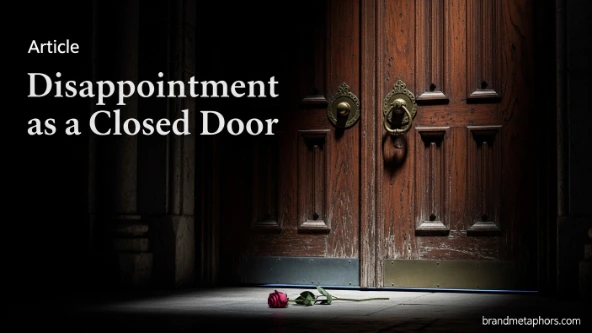
Few metaphors are as direct yet powerful as a closed door. It represents finality and separation from what could have been.
Meaning & Explanation
This metaphor highlights missed opportunities and abrupt endings.
Example Sentence
- “The rejection felt like a heavy door slamming shut just as I reached for the handle.”
Alternative Expressions
- Locked future
- Shut pathway
- A door without a key
Emotional & Sensory Detail
The sound of a door closing echoes. There’s finality—no gentle transition, just an end.
Cultural Reference
Many fairy tales use doors as symbols of fate—opening them leads to magic; closing them ends possibilities.
Interactive Exercise
Write two sentences:
- A door opening moment in your life
- A door closing moment Use emotional contrast between hope and disappointment.
5. Disappointment as a Rain on a Parade: When Joy Gets Interrupted
Rain during a parade is unexpected and unwelcome. It doesn’t destroy everything, but it dulls the celebration.
Meaning & Explanation
This metaphor captures interrupted joy—when something good is happening, but disappointment interferes.
Example Sentence
- “His criticism felt like rain on a parade I had been waiting months to join.”
Alternative Expressions
- Storm on celebration day
- Cloud over happiness
- Sudden downpour on joy
Sensory Detail
Drums fade under rain. Colors blur. Music becomes muffled.
Mini Storytelling Moment
A family gathers for graduation photos. Laughter fills the air. Suddenly, bad news arrives. Smiles remain, but slightly frozen.
Interactive Exercise
Describe a happy moment in your life that was interrupted. Add a “weather metaphor” to show emotional change.
6. Disappointment as a Bursting Bubble: When Magic Disappears Instantly
A soap bubble is beautiful because it is temporary. When it bursts, there is no trace left—only air.
Meaning & Explanation
This metaphor represents sudden realization that something was never as solid as it seemed.
Example Sentence
- “My excitement burst like a soap bubble the moment I understood the truth.”
Alternative Expressions
- Pop of illusion
- Shattered bubble of hope
- Vanishing dream sphere
Emotional Layer
There is a childlike loss here—something delicate disappears instantly.
Interactive Exercise
Think of one expectation that ended quickly. Write it as a bubble moment. Focus on speed and surprise.
7. Disappointment as a Long Shadow: When Sadness Follows You
A shadow grows when light is blocked. It follows you quietly, always attached.
Meaning & Explanation
This metaphor represents lingering disappointment that doesn’t vanish quickly.
Example Sentence
- “Even after the event passed, disappointment stayed like a long shadow behind me.”
Alternative Expressions
- Emotional shadow
- Lingering darkness
- Following silence
Literary Connection
Gothic literature often uses shadows to symbolize emotional burdens or unresolved feelings.
Interactive Exercise
Write about a disappointment that stayed with you for days or weeks. Describe it as a shadow—what shape does it take?
8. Disappointment as a Torn Letter: Messages That Never Fully Arrive
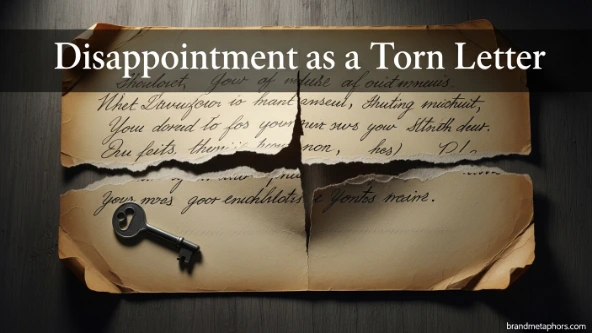
A torn letter suggests communication that is incomplete or damaged.
Meaning & Explanation
This metaphor reflects misunderstood expectations or broken communication.
Example Sentence
- “The apology felt like a torn letter—words were there, but meaning was missing.”
Alternative Expressions
- Fragmented message
- Incomplete story
- Broken communication thread
Sensory Detail
Paper edges are jagged. Words are missing. You try to piece them together.
Interactive Exercise
Write a short “letter” describing your disappointment, but intentionally leave parts incomplete.
9. Disappointment as a Distant Thunder: When Trouble Feels Far but Approaching
Thunder far away signals something coming, but not yet arrived.
Meaning & Explanation
This metaphor reflects anticipation of disappointment before it fully arrives.
Example Sentence
- “I could feel disappointment like distant thunder before the results were even announced.”
Alternative Expressions
- Emotional storm approaching
- Rumbling uncertainty
- Far-off warning
Emotional Detail
You don’t see the storm yet—you just feel it in the air.
Interactive Exercise
Think of a situation where you sensed disappointment coming. Describe the “weather signs” before it arrived.
10. Transforming Disappointment: Turning Emotional Metaphors into Growth
Disappointment metaphors are not only expressive—they are transformative. They help you process emotions by giving them shape.
When you say “deflated balloon,” you can also imagine reinflating it. When you say “closed door,” you can imagine another opening nearby.
Practical Tips for Using These Metaphors
- Use them in journaling to clarify emotions
- Add them in storytelling for emotional depth
- Use them in social media captions for relatability
- Mix metaphors carefully for creative writing
Writing Prompt
Combine two metaphors:
- A “dying flame behind a closed door”
- A “cracked mirror under rain”
What new emotion does it create?
Bonus Tip
Don’t overuse metaphors in a single piece. One strong image often carries more emotional weight than many weak ones.
Conclusion
Disappointment is inevitable, but silence about it is not. Metaphors give language to what otherwise stays hidden in emotional corners. They turn invisible feelings into something you can hold, examine, and eventually release.
Whether it is a deflated balloon, a closed door, or a fading flame, each metaphor is a reminder: disappointment is not the end of meaning—it is part of the human story of expectation and reality.
And in that space between what we hoped for and what actually happens, language becomes a bridge.
FAQs: Metaphors for Disappointment
1. What are metaphors for disappointment?
They are creative expressions that describe feelings of letdown using imagery like broken objects, weather, or fading light.
2. Why are metaphors useful for expressing disappointment?
They help people understand and communicate complex emotions in a more vivid and relatable way.
3. Can metaphors improve writing skills?
Yes, they make writing more engaging, emotional, and descriptive, especially in storytelling and poetry.
4. What is a simple metaphor for disappointment?
“A deflated balloon” is one of the simplest and most widely used metaphors.
5. How can I create my own metaphors for disappointment?
Think of how disappointment feels (heavy, empty, fading) and match it with physical objects or natural phenomena that share those qualities.
If you’d like, I can also turn this into a SEO blog post format with meta title, keywords, and slug for publishing.