
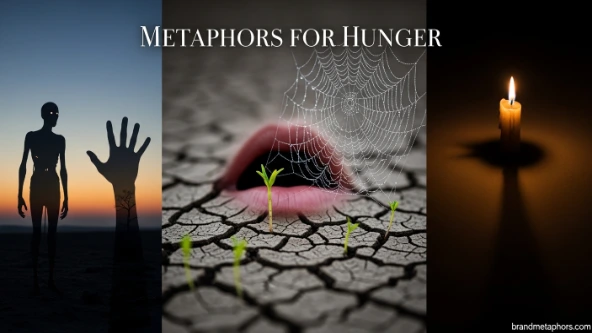
A Sensory Hook: When Hunger Becomes More Than an Empty Stomach
There is a moment—somewhere between late afternoon and nightfall—when the body stops politely asking and begins insisting. The stomach tightens like a clenched fist, thoughts drift toward food like birds circling a single field, and even the air seems to carry invisible flavors: warm bread, spice, smoke, sweetness. Hunger, in its rawest form, is not quiet. It speaks in rhythms, in echoes, in sudden distractions that make everything else feel distant.
But hunger is not always about food. Sometimes it is the name we give to longing itself—the craving for comfort, success, love, or meaning. That is why metaphors for hunger matter so deeply in language and storytelling. They allow writers, speakers, and even everyday thinkers to express desire in ways that feel alive, physical, and emotional.
In this article, we explore powerful metaphors for hunger, how they shape meaning, and how you can use them in writing, conversation, and creative expression.
Understanding Hunger Metaphors: When Language Feels Like Appetite
Hunger metaphors turn an invisible feeling into something we can see, hear, or touch. Instead of saying “I am very hungry,” language becomes richer and more expressive:
- “My stomach is a hollow drum.”
- “I could eat a horse.”
- “A fire is burning inside me.”
These expressions don’t just describe hunger—they perform it. They help readers feel the intensity rather than simply understand it.
Why is this important?
Because metaphors shape emotion. They transform simple communication into storytelling. Whether you’re writing fiction, poetry, social media captions, or personal reflections, hunger metaphors add depth, urgency, and relatability.
Metaphor 1: “A Roaring Fire in the Belly”
Meaning and Explanation
This metaphor describes hunger as something hot, alive, and demanding. The body is imagined as a furnace, and hunger as flames growing stronger with time.
It suggests urgency—not just needing food, but needing satisfaction immediately.
Example Sentence or Scenario
After skipping lunch and walking under the burning sun, Sam felt a roaring fire in his belly, every step reminding him how long it had been since his last meal.
Alternative Expressions
- “A furnace burning inside me”
- “Flames licking at my stomach”
- “An inner wildfire of hunger”
Sensory and Emotional Details
This metaphor brings heat, pressure, and restlessness. You can almost feel the warmth spreading, the impatience building, the body demanding fuel like a machine overheating.
Mini Story
A traveler lost in a desert walks for hours without food or water. The sun presses down like a heavy hand. Inside him, hunger becomes more than discomfort—it becomes fire. Every thought sharpens into one idea: eat. When he finally finds an oasis village, the first bite of bread feels like rain falling on flames.
Interactive Prompt
Think of a time you were extremely hungry. Could you describe it as heat or fire? Try rewriting your memory using this metaphor in three different sentences.
Metaphor 2: “An Empty House Echoing Inside”
Meaning and Explanation
This metaphor portrays hunger as emptiness, silence, and echoing space. The body becomes a deserted house—rooms without furniture, sound bouncing off bare walls.
It often represents deeper emotional hunger too, such as loneliness or longing.
Example Sentence or Scenario
She hadn’t eaten since morning, and by evening, she felt like an empty house echoing inside, every step reminding her of the silence in her stomach.
Alternative Expressions
- “A hollow chamber within me”
- “A vacant room in my body”
- “Silence ringing through my stomach”
Sensory and Emotional Details
This metaphor is cold, quiet, and emotionally heavy. Unlike fire, it does not burn—it empties. It creates a sense of loneliness and longing, like something important is missing.
Mini Story
A young student moves to a new city for university. Days pass in busyness, but meals are often skipped. One night, sitting alone in her small room, she realizes it is not just hunger for food—it is hunger for home, for familiarity. The room feels like a house without furniture, echoing with absence.
Interactive Prompt
Write a short paragraph describing emotional hunger (loneliness, homesickness, or desire) using the “empty house” metaphor.
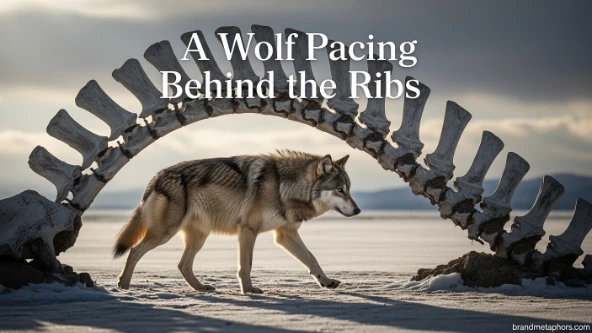
Metaphor 3: “A Wolf Pacing Behind the Ribs”
Meaning and Explanation
This metaphor gives hunger a wild, living presence. It is not passive—it is a creature inside the body, restless and pacing, demanding attention.
The wolf represents instinct, survival, and urgency.
Example Sentence or Scenario
By midnight, after a long day of work, he felt a wolf pacing behind his ribs, restless and relentless, urging him toward the kitchen.
Alternative Expressions
- “A beast roaming inside my stomach”
- “A wild animal scratching at my insides”
- “A restless predator of hunger”
Sensory and Emotional Details
This metaphor adds tension, movement, and unpredictability. You can almost hear footsteps inside the body, a low growl of need. It feels primal and uncontrollable.
Mini Story
In a snowy mountain village, a hunter returns late after a failed trip. He has eaten nothing since morning. As the wind howls outside, inside him something stirs—hungry, sharp, alive. It is not just hunger anymore; it is instinct, pacing like a trapped wolf, reminding him that survival comes first.
Interactive Prompt
Describe your strongest craving (food or otherwise) as if it were an animal inside you. What animal would it be and why?
Hunger Beyond Food: Emotional and Symbolic Appetite
Hunger is rarely just physical. We also hunger for:
- Attention and recognition
- Love and belonging
- Success and achievement
- Meaning and purpose
When we say “I am hungry for success,” we are using physical sensation to express emotional intensity.
This blending of physical and emotional language makes metaphors powerful. It connects body and mind, making abstract feelings more relatable.
For example:
- “He was hungry for attention” suggests emotional need.
- “She starved for affection” suggests emotional deprivation.
These expressions reveal that hunger is not always about food—it is about desire in all its forms.
Hunger in Literature and Culture: From Stories to Survival
Writers across history have used hunger to symbolize deeper struggles.
One of the most famous literary moments comes from Charles Dickens’ Oliver Twist, where a child asks for more food with simple, heartbreaking honesty: “Please, sir, I want some more.” That moment is not just about hunger—it is about poverty, dignity, and survival.
In many cultures, hunger appears in folktales as a test of endurance or morality, survival stories, it represents human fragility. In poetry, it often symbolizes longing for love or spiritual fulfillment.
Even religious texts frequently use hunger metaphorically:
- “Hunger for righteousness”
- “Thirst for truth”
These expressions show that hunger is a universal human language.
Using Hunger Metaphors in Writing and Storytelling
If you want to make your writing more vivid, hunger metaphors are powerful tools.
Here’s how to use them effectively:
1. Match metaphor to emotion
- Fire = urgency, anger, intensity
- Empty house = loneliness, sadness
- Wolf = instinct, survival, desire
2. Avoid overuse
Too many metaphors can weaken impact. Choose one strong image and build around it.
3. Combine senses
Add texture, sound, or temperature:
- “A fire crackling in my hollow stomach”
- “An empty house of silence and cold hunger”
4. Show, don’t explain
Instead of saying “I was hungry,” show it:
- “My thoughts circled food like lost birds.”
Interactive Creative Exercises for Readers
Try these creative challenges:
Exercise 1: Metaphor Transformation
Rewrite this sentence in three metaphorical ways: “I am very hungry.”
Use:
- Fire metaphor
- Animal metaphor
- Space/emptiness metaphor
Exercise 2: Emotional Mapping
Choose an emotion (loneliness, ambition, love). Now describe it using hunger imagery.
Exercise 3: Micro-Story Writing
Write a 5–6 sentence story where hunger is a character (fire, wolf, or empty house).
Exercise 4: Social Media Practice
Create a caption using a hunger metaphor, such as:
- “Running on a fire in my belly and no breakfast in sight.”
Bonus Tips: Using Hunger Metaphors in Daily Life and Content
Hunger metaphors are not just for literature—they can enhance everyday communication.
In Writing
Use them in:
- Poetry
- Short stories
- Blog posts
- Personal essays
In Social Media
They make captions more expressive:
- “A wolf is pacing inside me… and it wants snacks.”
- “Empty house mode: please send food.”
In Speech
They can make storytelling more engaging:
- “By the time I reached home, I was basically a walking furnace of hunger.”
In Personal Reflection
They help you understand emotions better:
- Are you really hungry for food—or for rest, comfort, or connection?
FAQs About Metaphors for Hunger
1. What is a metaphor for hunger?
A metaphor for hunger is a figurative expression that describes hunger using imagery like fire, animals, or emptiness instead of literal words.
2. Why are hunger metaphors effective in writing?
They make emotions vivid, relatable, and sensory, helping readers feel the experience instead of just understanding it.
3. Can hunger metaphors describe emotions other than food cravings?
Yes. They are often used to express emotional desires such as love, ambition, loneliness, or success.
4. What are some common hunger metaphors?
Examples include “a roaring fire in the belly,” “an empty house inside,” and “a wolf pacing behind the ribs.”
5. How can I improve my use of metaphors in writing?
Practice observing emotions closely, choose strong sensory images, and avoid mixing too many metaphors in one sentence.
Conclusion
Hunger is one of the most primal human experiences, yet language transforms it into something far richer than biology. Through metaphors—fire, emptiness, wolves, echoes—we give shape to desire itself.
These images allow us to speak not just of food, but of longing, ambition, loneliness, and life’s deeper cravings. Whether in literature, conversation, or creative writing, hunger metaphors remind us that words can be as powerful as sensations.
And perhaps that is the most interesting truth: we are all, in one way or another, always hungry—for something more.