
Introduction: Standing at the Edge of Something Vast
The first time many people see a mountain up close, they fall silent. The air feels thinner, cooler, almost sacred. Jagged peaks rise like ancient guardians against the sky, unmoving while clouds drift past like passing thoughts. Mountains have a strange effect on us. They make our problems feel smaller, yet they also awaken something enormous inside us — courage, wonder, fear, ambition.
That is why mountain metaphors are so powerful in writing and conversation. A mountain is never just a pile of rock. It can symbolize struggle, wisdom, growth, isolation, strength, peace, or even destiny. Writers, poets, speakers, and storytellers have used mountains for centuries to express emotions that ordinary language cannot fully hold.
Whether you are crafting poetry, writing captions, improving essays, creating stories, or simply searching for vivid ways to describe life, mountain metaphors can add emotional depth and unforgettable imagery. They help readers feel the height of an obstacle, the beauty of resilience, or the loneliness of standing above the crowd.
In this guide, you will discover creative metaphors for mountains, practical writing tips, cultural references, exercises, and examples you can use in daily life, storytelling, and social media. By the end, you may never look at a mountain — or your own challenges — the same way again.
Why Mountains Make Such Powerful Metaphors
Mountains naturally carry emotional weight. They are massive, ancient, and difficult to conquer. Unlike rivers or storms, mountains stay rooted in place. That permanence gives them symbolic power.
People often associate mountains with:
- Challenges and obstacles
- Wisdom and age
- Spiritual journeys
- Ambition and achievement
- Isolation and solitude
- Stability and endurance
- Freedom and perspective
Think about famous cultural references. In Greek mythology, Mount Olympus was home to the gods. In literature, mountains often represent personal transformation. Even in everyday speech, we say someone has “a mountain of work” or must “climb uphill” through difficulty.
Because mountains connect physical experience with emotional meaning, they create vivid mental pictures instantly.
Mountain Metaphors for Life Challenges
Life rarely moves in a straight line. Sometimes it rises steeply, forcing us to climb one exhausting step at a time. This is why mountains often symbolize hardship.
Example 1: “Life is a mountain climb.”
Meaning: Progress takes effort, patience, and endurance.
Example Sentence: “After losing his job, Daniel treated recovery like a mountain climb — slow, painful, but possible.”
Alternative Expressions:
- An uphill journey
- A rocky ascent
- Scaling impossible heights
Sensory Detail: Imagine cold wind against your face, aching muscles, and the distant summit hidden by clouds.
This metaphor works beautifully in motivational writing, speeches, and personal essays.
Mini Storytelling Example
A young athlete trains every dawn while the city still sleeps. Every practice feels endless. Yet day after day, she climbs her invisible mountain until one day she stands victorious before thousands. The mountain was never the competition. It was the discipline required to reach it.
Metaphors for Mountains as Symbols of Strength
Mountains survive storms, earthquakes, and centuries of erosion. That makes them excellent symbols of resilience and inner power.
Example 2: “She stood like a mountain.”
Meaning: Someone remains strong and unshaken during hardship.
Example Sentence: “Even during the crisis, their grandmother stood like a mountain for the entire family.”
Alternative Ways to Express It:
- Solid as granite
- Unmoved by storms
- Rooted like stone
Emotional Tone: Calm, dependable, powerful.
This metaphor is especially effective in emotional storytelling because it turns a person into a force of nature.
Literary Reference
In Ernest Hemingway’s works, natural imagery often reflects emotional endurance. Mountains frequently symbolize quiet strength and emotional distance.
Spiritual and Emotional Mountain Metaphors
Mountains are deeply tied to spirituality across cultures. People climb mountains seeking clarity, enlightenment, or peace.
Example 3: “The mountain inside me finally grew quiet.”
Meaning: Inner conflict or emotional chaos has settled.
Example Sentence: “After years of anxiety, meditation made the mountain inside me finally grow quiet.”
Alternative Expressions:
- Inner storms faded
- The peak softened into silence
- Emotional cliffs became valleys
Sensory Imagery: Still snow, thin air, soft echoes, sunrise over distant ridges.
This kind of metaphor works beautifully in reflective writing, poetry, and journaling.
Creative Metaphors for Mountains in Poetry
Poets often use mountains to create atmosphere and emotional texture.
Here are several poetic mountain metaphors:
MetaphorMeaningMountains are sleeping giantsHidden power or ancient wisdomMountains are the earth’s spineStrength and structureMountains are stone wavesFrozen motion and beautyMountains are stairways to heavenSpiritual aspirationMountains are silent teachersWisdom through stillness
Example Poetic Sentence
“The mountains crouched beneath the moon like ancient kings guarding forgotten worlds.”
Notice how this creates mystery and scale immediately.
Writing Tip
Combine mountain imagery with weather or light for richer descriptions:
- Golden mountains at dawn
- Mountains swallowed by fog
- Thunder rolling across black peaks
These combinations make metaphors more cinematic.
Mountain Metaphors in Everyday Language
You do not need to write novels to use mountain metaphors. They appear naturally in daily conversation.
Common examples include:
- “I have a mountain of laundry.”
- “That exam feels like Mount Everest.”
- “We climbed a mountain just to finish the project.”
- “Her confidence towered like a mountain.”
These phrases work because people instantly understand the emotional scale.
Bonus Tip for Social Media
Mountain metaphors create memorable captions:
- “Every summit begins with one difficult step.”
- “Built like mountains, not waves.”
- “Some battles are climbed, not fought.”
- “The view is worth the climb.”
Short, visual metaphors perform especially well on platforms like Instagram and Pinterest.
How to Create Your Own Mountain Metaphors
The strongest metaphors feel personal and original. Instead of copying familiar phrases, build your own mountain imagery.
Here is a simple strategy:
Step 1: Identify the Emotion
Ask yourself:
- Is the feeling heavy?
- Lonely?
- Inspiring?
- Overwhelming?
- Peaceful?
Step 2: Match Mountain Qualities
Mountains can be:
- Tall
- Cold
- Silent
- Dangerous
- Beautiful
- Ancient
- Difficult to climb
Step 3: Blend the Two
Example:
Emotion: grief Mountain quality: cold isolation
Metaphor: “Grief rose around her like a frozen mountain range.”
Practice Prompt
Complete these sentences:
- My fear was a mountain because…
- Her ambition climbed like…
- The city skyline looked like…
- Silence settled over the room like…
Creative exercises like these strengthen metaphor skills quickly.
Famous Mountain Symbolism in Literature and Culture
Mountains appear in stories across the world because they represent transformation.
In Mythology
- Mount Olympus represented divine power in Greek mythology.
- Mount Sinai symbolizes revelation in religious tradition.
- In many Asian traditions, mountains represent spiritual enlightenment.
In Literature
Mountain journeys often mirror emotional growth.
For example:
- In fantasy novels, heroes climb mountains before discovering truth.
- In survival stories, mountains test human endurance.
- Romantic poetry uses mountains to express awe and loneliness.
Real-Life Example
Mountaineers often describe climbing as deeply emotional rather than merely physical. Sir Edmund Hillary famously described the conquest of Everest as overcoming himself as much as the mountain.
This is why mountain metaphors resonate so strongly. They reflect both external struggle and internal transformation.
Descriptive Words and Phrases for Mountain Imagery
Sometimes writers struggle to make mountain metaphors vivid. Strong descriptive language helps enormously.
Words Associated with Mountains
Strength
- Rugged
- Towering
- Granite
- Immovable
- Mighty
Beauty
- Snow-capped
- Misty
- Golden
- Majestic
- Wild
Emotion
- Lonely
- Silent
- Brooding
- Ancient
- Watchful
Example Combination
“The brooding mountains loomed beneath a bruised purple sky.”
That single sentence creates mood, color, scale, and emotion together.
Bonus Writing Tip
Use sensory details:
- Smell of pine
- Sharp cold air
- Echoing wind
- Crunching snow
- Thin sunlight
Sensory imagery makes metaphors feel alive.
Interactive Exercises to Practice Mountain Metaphors
The best way to master metaphors is through practice.
Exercise 1: Emotion Mapping
Choose one emotion:
- Joy
- Fear
- Anger
- Hope
- Loneliness
Now describe it as a mountain.
Example: “Hope was a distant mountain glowing beneath sunrise.”
Exercise 2: Rewrite Plain Sentences
Turn these ordinary sentences into metaphorical ones.
Plain:
“The task was difficult.”
Metaphorical:
“The task rose before him like a cliff no rope could reach.”
Try these:
- “She was calm.”
- “I felt overwhelmed.”
- “They were ambitious.”
Exercise 3: Create a Story Opening
Write three sentences beginning with mountain imagery.
Example: “The mountain watched over the village like an ancient guardian. Every winter its shadow swallowed the valley before sunset. The villagers believed it remembered every secret ever spoken beneath it.”
This exercise improves atmosphere and storytelling immediately.
Using Mountain Metaphors in Different Types of Writing
Mountain metaphors are versatile. Different genres use them differently.
In Poetry
Focus on emotional imagery and rhythm.
Example: “Your silence became a mountain between us.”
In Fiction
Use mountains to shape setting and character emotion.
Example: “The mountain road twisted like doubt through the dark.”
In Motivational Writing
Mountains symbolize persistence and achievement.
Example: “Success is not reaching the summit once. It is learning to keep climbing.”
In Business or Leadership Writing
Mountains can represent goals or challenges.
Example: “Every company faces mountains that test vision and resilience.”
In Social Media Content
Keep metaphors short and visual.
Example Captions:
- “Storm-tested like stone.”
- “Climbing quietly.”
- “Even mountains begin underground.”
Common Mistakes When Writing Mountain Metaphors
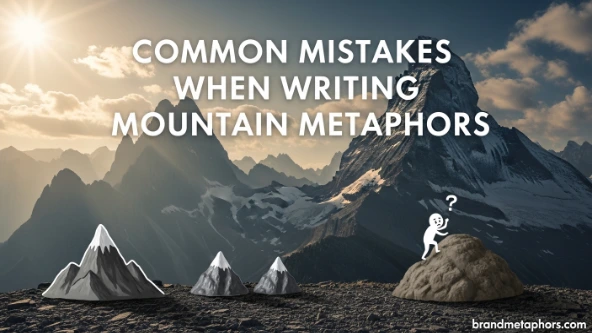
Even beautiful metaphors can lose impact if overused.
Mistake 1: Using Clichés Too Often
Phrases like “climbing mountains” are powerful but common.
Try fresh versions:
- “The challenge rose like frozen cliffs.”
- “Her doubts formed an endless ridge line.”
Mistake 2: Mixing Too Many Images
Avoid combining unrelated metaphors.
Confusing: “His mountain of fear drowned like an ocean storm.”
Better: “His fear stood before him like a black mountain.”
Mistake 3: Overwriting
Sometimes simple imagery is strongest.
Instead of: “The majestic eternal mountain stretched infinitely into celestial glory…”
Try: “The mountain cut sharply into the pale sky.”
Clean writing feels more powerful.
Bonus Tips for Writing Better Mountain Metaphors
Observe Real Landscapes
Study photographs or visit mountains if possible. Notice:
- Light changes
- Textures
- Weather patterns
- Colors at sunrise and dusk
Real observation creates authentic imagery.
Read Nature Writers
Writers like John Muir, Mary Oliver, and Jack London use natural imagery brilliantly.
Pay attention to how they describe silence, distance, and scale.
Use Contrast
Mountains become more dramatic when contrasted with something small.
Example: “The child stood beneath the mountain like a candle before a cathedral.”
Contrast creates emotional impact instantly.
Connect Mountains to Human Emotion
The best metaphors are emotionally true.
Instead of merely describing appearance, describe feeling:
- Heavy like mountains
- Silent like snowy peaks
- Jagged like heartbreak
Emotion transforms description into art.
FAQs About Metaphors for Mountains
1. What do mountains usually symbolize in metaphors?
Mountains commonly symbolize challenges, strength, ambition, wisdom, spirituality, and personal growth. Their height and permanence make them emotionally powerful symbols.
2. Why are mountain metaphors effective in writing?
They create vivid imagery and emotional depth. Readers instantly understand the ideas of struggle, endurance, and achievement through mountain comparisons.
3. Can mountain metaphors be used in everyday conversation?
Yes. Phrases like “a mountain of work” or “an uphill battle” are common examples of mountain metaphors in daily speech.
4. How can I create original mountain metaphors?
Focus on specific emotions or situations, then connect them to mountain qualities such as height, silence, danger, or endurance. Add sensory details for originality.
5. Are mountain metaphors only used in poetry?
No. They appear in fiction, speeches, motivational writing, social media captions, journaling, and even business communication.
Conclusion
Mountains have always captured human imagination. They rise above ordinary landscapes, reminding us of both our smallness and our potential. That same emotional power makes mountain metaphors unforgettable in writing.
A mountain can become fear. It can become hope. It can become resilience, silence, ambition, heartbreak, or transformation. With the right imagery, a single metaphor can carry the emotional weight of an entire story.
The next time you write about struggle, strength, dreams, or change, look toward the mountains. Listen to their silence. Notice their shadows, their storms, their impossible heights. Somewhere within those ancient peaks lies a metaphor waiting to give your words greater depth and beauty.
And perhaps, as every climber eventually learns, the real summit is not the mountain itself — but the person you become while rising toward it.