
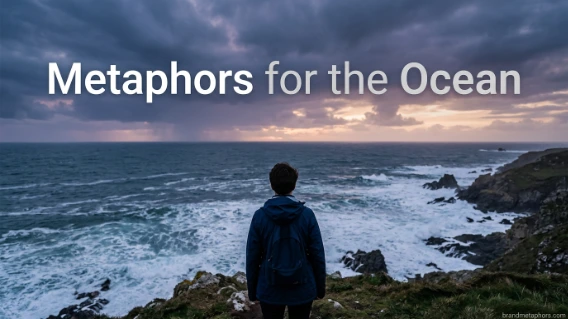
The first time you stand at the edge of the ocean, something shifts inside you. The air tastes faintly of salt, the wind tugs at your clothes like an impatient storyteller, and the waves arrive one after another—never the same, yet somehow familiar.
You watch the horizon blur into the sky, and suddenly, the world feels both infinite and intimate.
The ocean has always been more than water. It is a mirror, a mystery, a metaphor.
Writers, poets, and thinkers across centuries have turned to the ocean to describe everything from human emotions to the passage of time.
Why? Because the ocean is vast enough to hold contradictions—calm yet chaotic, beautiful yet dangerous, shallow at the edges yet unfathomably deep. It becomes the perfect language when words alone fall short.
In this article, we’ll explore powerful metaphors for the ocean, understand their meanings, and learn how to use them creatively in writing, storytelling, and everyday expression.
Why Use Ocean Metaphors in Writing and Life
Metaphors help us say more with less. They transform ordinary language into something vivid and memorable. When you compare something to the ocean, you instantly add layers of depth, emotion, and imagery.
The ocean is especially powerful because it connects to universal human experiences:
- Depth → emotions, thoughts, secrets
- Waves → change, rhythm, unpredictability
- Storms → conflict, chaos, inner turmoil
- Calm waters → peace, clarity, healing
Using ocean metaphors allows you to communicate complex feelings in a way readers can feel, not just understand.
1. The Ocean as a Mirror of Emotions
Meaning and Explanation
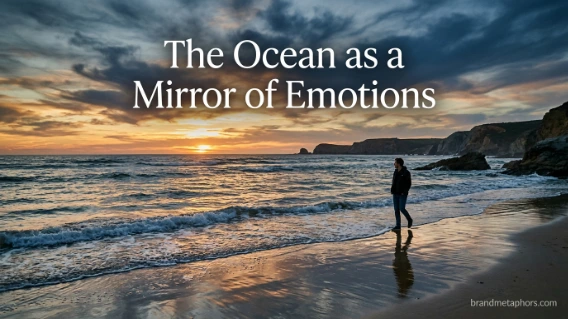
One of the most common and powerful metaphors is comparing the ocean to human emotions. Just like feelings, the ocean shifts constantly—calm one moment, stormy the next.
This metaphor works beautifully because emotions, like the sea, are not static. They rise, fall, crash, and recede.
Example Scenario
“Her thoughts churned like the ocean before a storm, restless and impossible to quiet.”
In this sentence, the ocean reflects inner turmoil—an emotional state that feels overwhelming and uncontrollable.
Alternative Expressions
- “His anger surged like crashing waves.”
- “Her sadness was a quiet tide, pulling everything inward.”
- “Joy rippled through him like sunlight dancing on water.”
Sensory & Emotional Details
Think of:
- The sound of waves crashing → intensity
- The stillness of calm water → peace
- The dark depths → hidden fears or secrets
Mini Storytelling Example
A young man sits alone on a beach after a difficult breakup. The sea is rough that evening, waves slamming into the shore with relentless force. As he watches, he realizes something—his emotions are not unique or permanent. Like the ocean, they will settle. The storm will pass.
Creative Practice Prompt
- Write a short paragraph describing your current mood as an ocean.
- Is it calm? Stormy? Deep? Shallow?
- Add at least three sensory details (sound, color, movement).
2. The Ocean as a Symbol of Time and Infinity
Meaning and Explanation
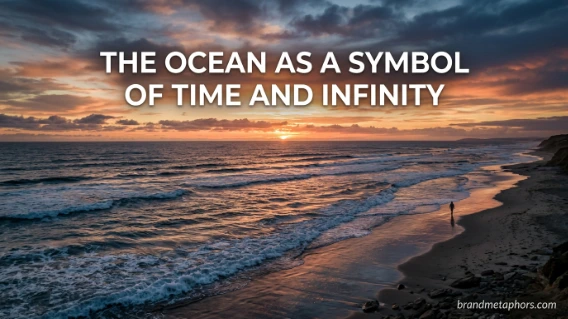
The ocean often represents endlessness—a powerful metaphor for time, eternity, or life itself. Its horizon seems infinite, reminding us how small we are in the grand scheme of things.
Example Sentence
“Time stretched before her like an endless ocean, vast and unknowable.”
Here, the ocean symbolizes both opportunity and uncertainty.
Alternative Ways to Express It
- “Life is an ocean with no visible shore.”
- “His future rolled out like an endless sea.”
- “Memories drifted like tides, coming and going without warning.”
Cultural & Literary Touch
In many cultures, the ocean is seen as a gateway between worlds—life and death, known and unknown. Sailors once believed that crossing certain waters meant entering a different realm entirely.
Mini Storytelling Example
An elderly woman stands by the sea, watching the waves as the sun sets. Each wave reminds her of a year gone by—some gentle, some harsh, all part of the same vast ocean of time.
Creative Practice Prompt
- Write a metaphor comparing your life journey to the ocean.
- Include a beginning (shore), middle (waves), and unknown future (horizon).
3. The Ocean as a Force of Power and Mystery
Meaning and Explanation
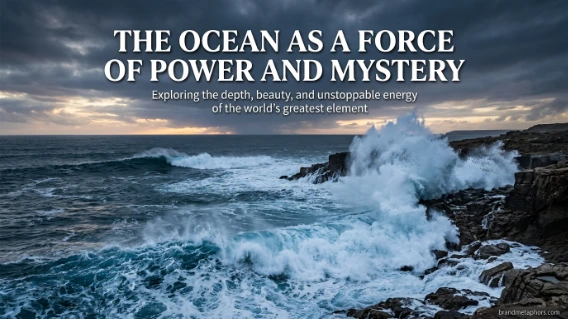
The ocean is both beautiful and terrifying. It holds secrets in its depths—creatures we’ve never seen, landscapes we’ve never explored. As a metaphor, it represents the unknown, power, and mystery.
Example Sentence
“His mind was an ocean, filled with depths no one had yet explored.”
This suggests complexity, intelligence, and hidden layers.
Alternative Expressions
- “Her silence was an ocean, deep and unreadable.”
- “The truth lay buried beneath the surface like the ocean floor.”
- “Fear rose within him like a sudden tidal wave.”
Sensory Details
- Dark blue depths → mystery
- Cold water → fear or isolation
- Roaring waves → uncontrollable power
Real-Life Reflection
Think about how little of the ocean we’ve actually explored. This makes it a perfect metaphor for the human mind, relationships, and even the universe.
Mini Storytelling Example
A writer struggles to understand a character she’s creating. She describes him as an ocean—calm on the surface, but hiding storms and secrets beneath. As she writes, she slowly “dives deeper,” uncovering his story layer by layer.
Creative Practice Prompt
- Describe a person you know as an ocean.
- What lies beneath their surface?
- Are they calm, stormy, or mysterious?
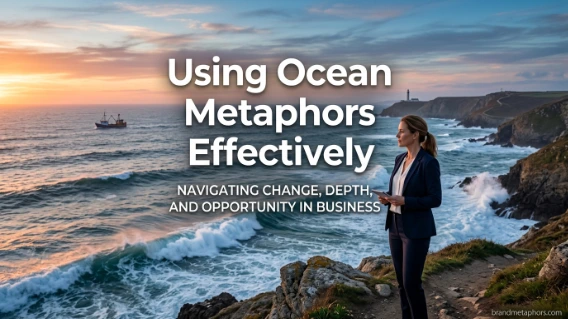
Bonus Tips: Using Ocean Metaphors Effectively
1. Match the Mood
Don’t use a calm ocean metaphor in a tense or dramatic moment. Align the imagery with the emotion.
2. Avoid Overused Phrases
Instead of “a sea of tears,” try something fresh like:
- “Tears pooled like a rising tide behind her eyes.”
3. Add Specific Details
The more vivid your description, the stronger the metaphor:
- Color (turquoise, gray, midnight blue)
- Movement (rippling, crashing, swirling)
- Sound (whispering waves, roaring surf)
4. Blend Metaphors Carefully
Stick to one main image. Mixing ocean metaphors with unrelated ones (like fire or mountains) can confuse readers.
Interactive Exercises to Practice Ocean Metaphors
Exercise 1: Emotion Mapping
List five emotions (e.g., anger, love, fear, peace, excitement). Now describe each as a different ocean state.
Example:
- Anger → “a violent storm at sea”
- Peace → “a glassy, silent horizon at dawn”
Exercise 2: Social Media Caption Challenge
Write an Instagram-style caption using an ocean metaphor.
Example: “Some days I’m calm waters, other days I’m a storm—but I’m always the ocean.”
Exercise 3: Dialogue Writing
Write a short conversation where one character uses an ocean metaphor to explain how they feel.
Exercise 4: Story Starter
Begin a story with this line: “The ocean knew her secrets before anyone else did.”
Using Ocean Metaphors in Daily Life
You don’t have to be a novelist to use metaphors. They can enhance everyday communication:
- Journaling: Describe your day as an ocean journey.
- Conversations: Express emotions more vividly.
- Creative writing: Add depth to characters and scenes.
- Social media: Make posts more relatable and poetic.
SEO Keywords Recap (Naturally Integrated)
- metaphors for the ocean
- ocean metaphor examples
- ocean symbolism in writing
- creative metaphors for emotions
- ocean imagery in literature
Conclusion
The ocean is more than a setting—it’s a language. A way to express what feels too big, too deep, or too complex for ordinary words.
When you use ocean metaphors, you invite readers (or listeners) to feel what you’re saying. You give shape to emotions, meaning to experiences, and beauty to expression.
So the next time you struggle to describe something—pause, imagine the ocean, and ask yourself:
Is this a calm sea… or a storm waiting to break?
Let that answer guide your words.
FAQs About Metaphors for the Ocean
1. What is a metaphor for the ocean?
A metaphor for the ocean is a comparison that describes something (like emotions or life) using ocean imagery, without using “like” or “as.”
2. Why is the ocean commonly used in metaphors?
Because it represents depth, mystery, power, and change—qualities that closely reflect human emotions and experiences.
3. Can ocean metaphors be used in everyday writing?
Yes! They work well in journaling, social media captions, storytelling, and even conversations to make expressions more vivid.
4. How do I create original ocean metaphors?
Focus on specific ocean elements (waves, tides, storms, depth) and connect them to emotions or ideas. Add sensory details for uniqueness.
5. What are some simple ocean metaphor examples?
- “Her thoughts were an endless ocean.”
- “Anger crashed like waves inside him.”
- “His mind was deep as the sea.”
6. Are ocean metaphors suitable for all types of writing?
They work best in creative, descriptive, or emotional writing, but can also enhance speeches, essays, and reflective pieces when used carefully.