
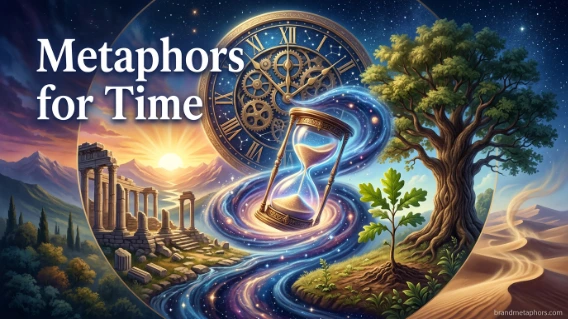
The clock on the wall ticks softly—steady, indifferent. A child watches it with impatience, waiting for a birthday to arrive. An elderly man glances at it and sighs, wondering where the years have gone. Somewhere between those two moments, time slips quietly through our fingers, unseen yet deeply felt.
Time is one of the most mysterious forces we experience. We cannot touch it, stop it, or store it—yet it shapes everything we are and everything we do. That’s where metaphors come in. They give us a language to describe the indescribable, turning time into something we can see, feel, and understand.
In this article, we’ll explore powerful metaphors for time, unpack their meanings, and learn how to use them creatively in writing, storytelling, and daily life.
Why Metaphors for Time Matter
Time is abstract. Without metaphors, it’s difficult to express how it feels. Is it rushing? Dragging? Healing? Slipping away?
Metaphors bridge that gap. They:
- Add emotional depth to writing
- Make communication more vivid and relatable
- Help us reflect on how we experience life itself
Think about it—saying “time passed quickly” is simple. But saying “time flew like a startled bird” paints a scene.
1. Time as a River: Flowing, Unstoppable, and Ever-Changing
Meaning & Explanation
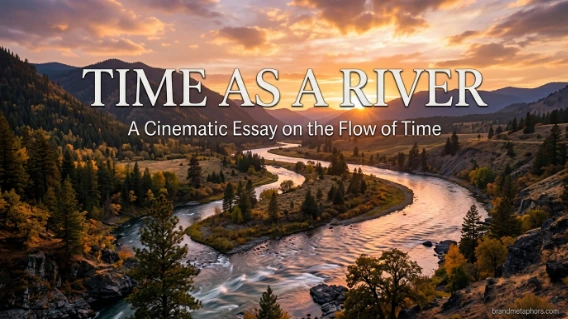
One of the most timeless metaphors (pun intended), comparing time to a river emphasizes its constant movement. Just like a river, time flows in one direction—forward—and never pauses for anyone.
Example Scenario
You sit by a riverside, watching leaves drift past. Each leaf is a moment, carried away, never to return. That’s time.
Example Sentence
“Time is a river, and we are all swept along in its current.”
Alternative Expressions
- Time flows like water
- Moments drift like leaves downstream
- Life moves like a winding stream
Sensory & Emotional Layer
This metaphor evokes calmness but also inevitability. There’s beauty in the flow—but also a quiet sadness in its irreversibility.
Mini Story
A young woman returns to her childhood home years later. The same river still flows behind it—but she realizes she is no longer the same person who once played by its banks. Time moved, just like the water.
2. Time as a Thief: Silent and Unforgiving
Meaning & Explanation
This metaphor highlights how time “steals” moments, youth, and opportunities without warning. It often carries a sense of regret or urgency.
Example Scenario
You look at an old photograph and barely recognize yourself. The years didn’t ask permission—they simply took what they wanted.
Example Sentence
“Time is a thief that steals our moments before we can hold them tight.”
Alternative Expressions
- Time slips away like a pickpocket in the night
- The hours vanish without a trace
- Youth is quietly taken by time
Emotional Tone
There’s a bittersweet edge here—loss, nostalgia, even fear. But it can also inspire appreciation for the present.
Cultural Reference
In many poems and classical literature, time is portrayed as something that robs beauty and vitality—reminding us that nothing lasts forever.
3. Time as a Healer: Gentle and Restorative

Meaning & Explanation
Unlike the previous metaphor, this one offers comfort. It suggests that time has the power to ease pain, mend emotional wounds, and bring perspective.
Example Scenario
After heartbreak, the pain feels endless. But slowly—day by day—it softens.
Example Sentence
“Time is a healer, stitching together the wounds we thought would never close.”
Alternative Expressions
- Time softens all pain
- Wounds fade with time
- The heart heals as the days pass
Sensory Details
Imagine warmth spreading through a cold room, slowly melting the chill. That’s how this metaphor feels—gradual, soothing, hopeful.
Real-Life Insight
While time doesn’t erase memories, it changes how we carry them. What once hurt deeply becomes something we can reflect on with strength.
Interactive Exercises: Practice Using Metaphors for Time
Exercise 1: Finish the Thought
Complete this sentence in your own way:
- “Time is like a __________ because __________.”
Try to avoid common answers. Be creative!
Exercise 2: Memory Mapping
Think of a moment in your life:
- A happy memory
- A difficult experience
Now describe time during that moment using a metaphor. Did it feel fast? Slow? Heavy? Light?
Exercise 3: Rewrite Plain Sentences
Turn these into metaphor-rich sentences:
- “The day went by quickly.”
- “I miss the past.”
- “Things got better over time.”
Bonus Tips for Using Time Metaphors in Writing & Daily Life

1. Match the Emotion
Choose metaphors that fit the mood:
- Happy → time as a dance, breeze, or song
- Sad → time as a shadow, storm, or fading echo
2. Avoid Overused Phrases (When Possible)
Instead of always saying “time flies,” try:
- “Time darted past like a nervous swallow.”
3. Use in Social Media
Metaphors make captions stand out:
- “Time slipped through my hands today—but left golden memories behind.”
4. Blend Metaphors with Storytelling
Don’t just state the metaphor—show it:
- Describe scenes, emotions, and sensory details
5. Keep It Natural
Metaphors should enhance meaning, not confuse it. Simplicity often works best.
More Creative Metaphors for Time (Quick Inspiration List)
- Time is a shadow—always present, always moving
- Time is a mirror—reflecting who we’ve become
- Time is a road—stretching endlessly ahead
- Time is a flame—burning steadily until it fades
- Time is a book—each day a new page
Use these as starting points and make them your own.
Using Metaphors for Time in Everyday Life
Metaphors aren’t just for writers. They can shape how you think and feel.
- Seeing time as a river can help you accept change
- Seeing time as a gift can increase gratitude
- Seeing time as a teacher can help you learn from mistakes
The way you describe time influences how you experience it.
FAQs About Metaphors for Time
What is a metaphor for time?
A metaphor for time is a figure of speech that describes time by comparing it to something else, making it easier to understand or feel.
Why are metaphors for time important in writing?
They add depth, emotion, and imagery, helping readers connect more deeply with the message.
What are the most common metaphors for time?
Popular ones include time as a river, thief, healer, road, or clock.
How can I create my own metaphor for time?
Think about how time feels to you in a specific moment, then compare it to something with similar qualities.
Can metaphors for time be used in everyday conversation?
Absolutely. They make your speech more expressive and memorable.
Conclusion
Time cannot be paused, rewound, or captured—but through metaphors, we can come close. We can turn it into rivers, thieves, healers, and countless other forms that help us understand its presence in our lives.
And maybe that’s the real beauty of metaphors—not just describing time, but making us more aware of it.
Because once you start seeing time as something vivid and alive, you stop taking it for granted.
We begin to notice the small moments. You begin to feel the passing seconds. You begin to live—more fully, more intentionally.
So the next time you glance at a clock, don’t just count the hours.
Ask yourself: What does time feel like right now?