
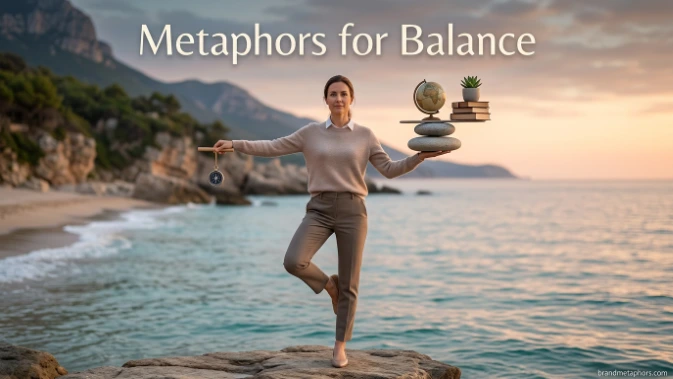
Imagine standing on a quiet beach with one foot on a smooth stone and the other on warm sand. The waves move, the wind shifts, and yet you find a steady place to stand. That small moment captures something much bigger: balance is not always about staying perfectly still. Instead, it is about adjusting when life moves around you.
Metaphors for Balance give writers a creative way to describe this idea without relying on plain words such as stability or harmony. They can make an essay more vivid, a poem more emotional, or a social media caption more memorable. Moreover, balance can describe much more than physical movement. It can represent relationships, emotions, work, choices, nature, and everyday life. Therefore, the right comparison can turn an ordinary thought into an image readers can easily feel and remember.
What Is Balance and Why Do We Need It?
Balance is often misunderstood as equal distribution: half work, half rest; equal time for everyone and everything. But real balance is dynamic, not static. It’s the ability to adjust, to shift weight, to respond to change without collapsing.
Think of it as alignment rather than equality.
Why does it matter?
- It prevents burnout
- It improves decision-making
- It creates emotional stability
- It allows creativity to flourish
Without balance, life becomes either chaotic or suffocating. With it, even complexity feels manageable.
Why Metaphors Help Us Understand Balance
Metaphors transform abstract ideas into something we can feel. Saying “maintain balance” is vague. Saying “walk the tightrope” creates tension, imagery, and emotional resonance.
They help us:
- Visualize invisible concepts
- Communicate complex feelings
- Add depth to writing and speech
- Connect emotionally with others
Let’s explore three powerful metaphors for balance—and how to use them.
Walking a Tightrope

Meaning & Explanation
Balance is like walking a tightrope—you must constantly adjust, focus, and stay aware. One rigid step or careless movement can throw you off.
Example Scenario
A student juggling studies, part-time work, and friendships feels overwhelmed. They realize they don’t need perfection—just small adjustments, like the tightrope walker shifting weight with each step.
Example sentence: “I’m walking a tightrope between ambition and exhaustion.”
Alternative Expressions
- Balancing on a wire
- Treading carefully
- Walking a fine line
Sensory & Emotional Detail
You can almost feel the rope beneath your feet, the wind nudging your body, your heart beating louder than the crowd below.
Mini Storytelling Touch
Imagine a performer in a dimly lit circus tent. The audience holds its breath—not because they expect perfection, but because they know the beauty lies in the struggle to stay upright.
Why It Works
This metaphor highlights that balance requires attention and flexibility, not stillness.
Riding the Waves
Meaning & Explanation
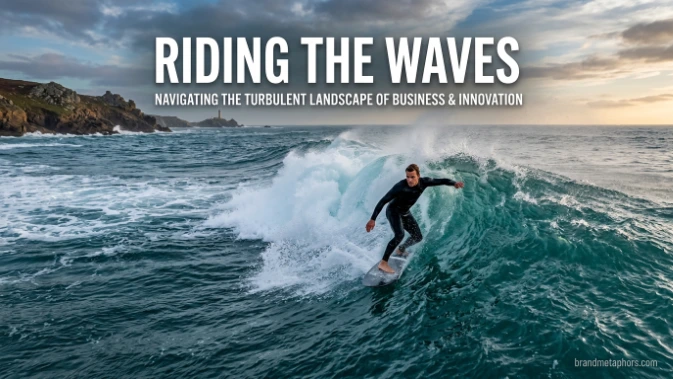
Balance is like surfing—you don’t control the waves, but you learn how to ride them. Life’s ups and downs are inevitable; balance comes from adapting.
Example Scenario
Someone dealing with emotional highs and lows learns not to fight feelings but to move through them.
Example sentence: “I’m learning to ride the waves instead of drowning in them.”
Alternative Expressions
- Going with the flow
- Navigating the tides
- Sailing through storms
Sensory & Emotional Detail
Salt on your lips, the rush of water beneath you, the thrill of staying upright despite the chaos.
Mini Storytelling Touch
Think of a surfer at dawn—waiting, watching, then rising with the wave. Not forcing it. Not resisting it. Just moving with it.
Why It Works
This metaphor teaches acceptance: balance isn’t about control—it’s about response.
Tending a Fire
Meaning & Explanation
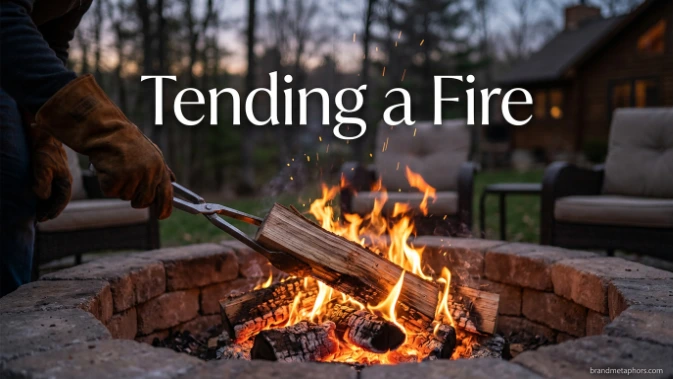
Balance is like maintaining a fire. Too much fuel, and it burns out of control. Too little, and it fades. You must feed it carefully.
Example Scenario
A professional pours all energy into work and burns out. They learn to pace themselves—adding fuel gradually.
Example sentence: “I’m learning to tend my energy like a fire—not letting it burn too fast.”
Alternative Expressions
- Keeping the flame alive
- Managing the heat
- Feeding the fire wisely
Sensory & Emotional Detail
The crackle of wood, the warmth on your skin, the quiet satisfaction of a steady flame.
Cultural/Literary Note
Fire has long symbolized life and energy—from ancient rituals to modern storytelling. It reminds us that balance is care, not force.
Why It Works
This metaphor emphasizes sustainability—balance as long-term care.
Creative Writing Prompts: Practice Balance Metaphors
Try these exercises to internalize the concept:
Personal Balance Metaphor
Write one paragraph describing your life using a metaphor for balance. Are you a tightrope walker? A sailor? A gardener?
Contrast Imbalance
Describe what imbalance feels like using the opposite metaphor:
- Falling off the rope
- Drowning in waves
- Watching a fire burn out
Dialogue Practice
Write a short conversation where one character explains balance using a metaphor.
Using Balance Metaphors in Writing
Metaphors can elevate your writing when used intentionally.
Tips:
- Match metaphor to tone (serious, poetic, casual)
- Avoid overusing mixed metaphors
- Keep imagery consistent
Example transformation:
Plain: “I feel overwhelmed.”
With metaphor: “I’m trying to stay upright on a rope that keeps swaying.”
Using Metaphors for Social Media & Everyday Life
Metaphors aren’t just for essays—they’re powerful in daily communication.
Examples:
- Instagram caption: “Learning to ride the waves 🌊”
- Journal entry: “Today I fed the fire just enough.”
- Conversation: “I’m walking a fine line right now.”
They make your thoughts more relatable and memorable.
Real-Life Examples of Balance
Balance shows up everywhere:
- Athletes pacing themselves in a marathon
- Artists balancing creativity and discipline
- Parents managing work and family
Even nature reflects it: ecosystems thrive through balance, not excess.
Expanding Your Metaphor Toolkit
Here are additional metaphors you can explore:
- Balancing scales – fairness and decision-making
- Spinning plates – managing multiple responsibilities
- A symphony orchestra – harmony between different elements
Each offers a slightly different lens.
Emotional Intelligence and Balance
Balance isn’t just physical or practical—it’s emotional.
Metaphors help us:
- Understand feelings
- Express vulnerability
- Communicate needs
Saying “I’m drowning” conveys more than “I’m stressed.”
Bonus Tips for Mastering Balance Metaphors
- Use sensory language (sound, touch, sight)
- Anchor metaphors in real experiences
- Keep them simple but vivid
- Revisit and refine your favorite ones
FAQs About Metaphors for Balance
What is a metaphor for balance?
A metaphor for balance is a comparison that helps explain the concept of stability and adjustment, such as walking a tightrope or riding waves.
Why are metaphors useful?
They make abstract ideas easier to understand and more emotionally engaging.
Can I create my own metaphor?
Absolutely! Personal metaphors often feel the most meaningful and authentic.
How do I avoid overusing metaphors?
Stick to one clear image at a time and ensure it fits your message.
Are metaphors only for writing?
No—they’re useful in speaking, teaching, journaling, and even thinking.
What is a metaphor for balance?
A metaphor for balance compares harmony or stability to a familiar image, such as a tightrope, calm lake, bridge, or musical chord.
What is a good metaphor for emotional balance?
A calm lake is a strong metaphor for emotional balance because its surface can be disturbed while still returning to peace.
What metaphor represents harmony?
A musical chord is an effective metaphor for harmony because different notes can work together to create one pleasing sound.
Can balance metaphors be used in essays?
Yes. Balance metaphors can make abstract ideas such as teamwork, leadership, emotional control, and fairness easier to understand and remember.
How can I create my own metaphor for balance?
First, decide what kind of balance you mean. Then choose a familiar object or scene that behaves in a similar way and explain the connection with a clear sensory detail.
Conclusion
Balance is not always perfect stillness or equal weight on every side. Instead, it can be movement, adjustment, cooperation, patience, and the ability to return to center.
A tightrope shows the effort required to stay steady. A calm lake captures emotional peace and recovery. A musical chord shows how different parts can work together without becoming identical.
Moreover, these images can be adapted for essays, poetry, stories, captions, school projects, and everyday conversations.
When you need to describe harmony or stability, look around you. A bridge, wave, tree, instrument, path, or quiet lake may already contain the idea you are trying to express.
Ultimately, balance is less about standing perfectly still and more about learning how to move without losing yourself.