
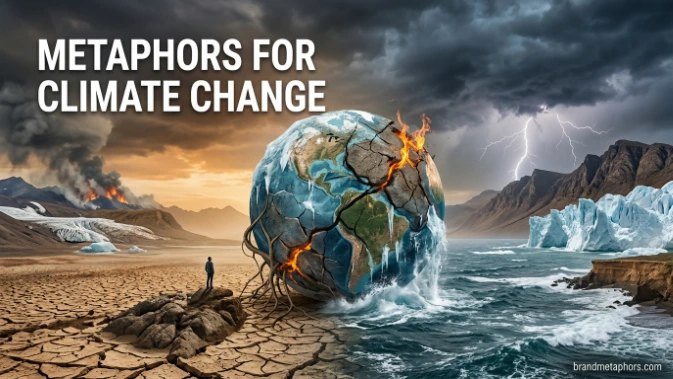
Imagine standing outside on a summer afternoon when the air feels unusually heavy, the sun seems harsher, and the usual cool breeze never arrives. Although one hot day is not proof of climate change, it can make a larger idea easier to picture. Metaphors for Climate Change help turn that large, complex issue into something people can see, feel, and understand. Instead of relying only on scientific terms, a strong metaphor can describe a warming planet as a fever, a warning light, or a slowly changing home. As a result, readers can connect global warming with everyday experiences and emotions. Moreover, these comparisons can make school projects, essays, stories, speeches, poems, and social media posts more memorable. Therefore, learning how to use climate change metaphors can help you explain environmental problems clearly without making your writing sound cold or overly technical.
Why Metaphors Matter in Climate Change Communication
Climate change is not just a scientific issue—it’s a storytelling challenge. Graphs and statistics are essential, but they often fail to stir emotion or inspire action. That’s where metaphors come in.
A metaphor doesn’t just explain—it transforms. It turns rising carbon levels into a “blanket” wrapped around the Earth, trapping heat. It makes deforestation feel like the planet “losing its lungs.” These images stick. They linger. They move people.
When we use metaphors, we:
- Simplify complex ideas
- Evoke emotional responses
- Make abstract concepts tangible
- Inspire action through imagination
Think of metaphors as tools—not just for writers, but for anyone who wants to communicate climate urgency in a way that resonates.
The Power of Imagery: Making the Invisible Visible

Climate change is often invisible in our daily lives. You can’t see carbon dioxide. You don’t feel sea levels rising—until you do.
Metaphors give shape to the unseen.
Instead of saying “global temperatures are rising,” imagine saying:
- “The Earth has a fever.”
- “Our planet is running a temperature it can’t shake.”
Suddenly, the issue becomes personal. We all understand what a fever means. It signals illness, imbalance, and the need for care.
This is the magic of metaphor—it turns data into something we can feel in our bones.
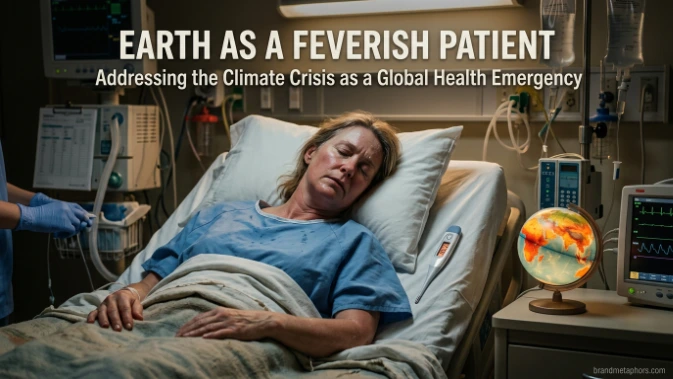
Earth as a Feverish Patient
Meaning and Explanation
This metaphor compares the planet to a sick human body. Climate change becomes an illness, and rising temperatures resemble a fever—a warning sign that something is wrong.
It emphasizes urgency and care. Just as we don’t ignore a high fever, we shouldn’t ignore global warming.
Example Scenario
Imagine a doctor looking at a chart:
“The patient’s temperature has been rising steadily for decades. If we don’t act now, the damage could become irreversible.”
Now replace “patient” with Earth—and the metaphor clicks into place.
Alternative Expressions
- “The planet is burning with a fever.”
- “Earth’s temperature is spiking like a sick body.”
- “We’re watching a slow-motion illness unfold.”
Sensory and Emotional Details
Picture the heat of a fever—sweaty skin, pounding pulse, restlessness. Now imagine that sensation scaled up to a planet. It creates discomfort, urgency, and empathy.
Mini Storytelling Element
In many cultures, illness is a call to action. Families gather, remedies are prepared, care is given. This metaphor invites us to treat Earth with the same compassion we would a loved one.
The Carbon Blanket
Meaning and Explanation
Greenhouse gases act like a thick blanket wrapped around the Earth, trapping heat that would otherwise escape into space.
This metaphor is widely used because it’s intuitive. Everyone knows how a blanket works—it keeps warmth in.
Example Sentence
“We’ve wrapped the Earth in a carbon blanket so thick that it can’t cool down at night.”
Alternative Ways to Express It
- “A heat-trapping quilt surrounds the planet.”
- “We’ve layered the sky with invisible insulation.”
- “The atmosphere is becoming a thermal trap.”
Sensory and Emotional Details
Imagine sleeping under too many blankets on a hot night. You toss and turn, trying to escape the heat. That discomfort mirrors what’s happening globally.
Real-Life Connection
Urban areas often feel hotter than surrounding regions—a phenomenon called the “urban heat island effect.” It’s like a localized version of the carbon blanket, making the metaphor even more relatable.
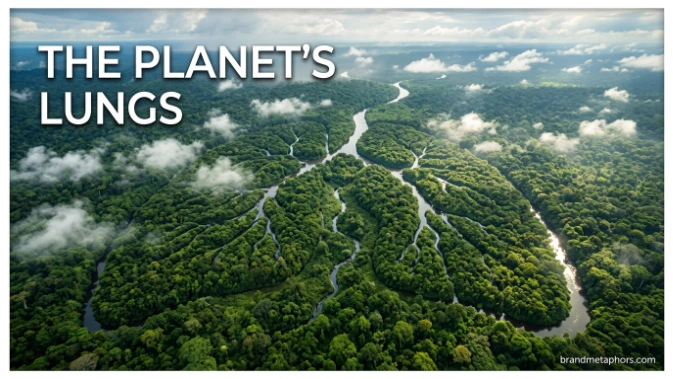
The Planet’s Lungs
Meaning and Explanation
Forests, especially rainforests, are often called the “lungs of the Earth” because they absorb carbon dioxide and release oxygen.
Deforestation, then, becomes a kind of suffocation.
Example Scenario
“Every tree cut down is like a breath the Earth can’t take.”
Alternative Expressions
- “We’re choking the planet by clearing its lungs.”
- “Forests are the breath of life—and we’re cutting it short.”
- “The Earth is gasping as its green lungs disappear.”
Sensory and Emotional Details
Think of the feeling of being out of breath—lungs burning, chest tightening. This metaphor taps into that primal fear and translates it into environmental urgency.
Cultural Reference
In literature and mythology, breath is often linked to life itself. From ancient creation stories to modern poetry, breath symbolizes existence. Losing it signals danger—and loss.
How to Create Your Own Climate Change Metaphors
Creating metaphors isn’t just for poets—it’s a skill anyone can develop.
Here’s a simple method:
- Identify the concept (e.g., rising sea levels)
- Think of a familiar experience (e.g., a bathtub filling up)
- Connect the two
Example:
- “The oceans are like a bathtub we forgot to turn off.”
The more personal and sensory your metaphor, the more powerful it becomes.
Interactive Exercise: Build Your Own Metaphor

Try this:
cue 1: Climate change is like ______ because ______.
Prompt 2: Deforestation feels like ______ when you imagine ______.
Prompt 3: The future of the planet reminds me of ______.
Write at least three metaphors. Don’t worry about perfection—focus on imagery and feeling.
Bonus challenge: Share your metaphor on social media and see how people respond.
Using Metaphors in Writing and Storytelling
Metaphors can elevate any piece of writing—from essays to social media posts.
Tips for Effective Use
- Keep it simple and relatable
- Avoid overloading with too many metaphors
- Match tone to audience
- Use sensory language (sight, sound, touch)
Example Transformation
Plain sentence:
“Climate change is causing serious problems.”
With metaphor:
“Climate change is a slow-moving storm gathering strength, and we’re standing in its path.”
The second version is more vivid, memorable, and emotionally engaging.
Metaphors in Social Media and Everyday Conversations

You don’t need to write an article to use metaphors. They work beautifully in:
- Tweets or captions
- Conversations with friends
- Classroom discussions
- Speeches or presentations
Quick Examples
- “The Earth isn’t just warming—it’s overheating.”
- “We’re playing with the planet like it’s a disposable toy.”
- “Nature is sending us warning signals—we just need to listen.”
Short, punchy metaphors can spread awareness quickly.
Common Pitfalls to Avoid
While metaphors are powerful, they can also mislead if used carelessly.
Avoid:
- Oversimplification that distorts facts
- Mixed metaphors that confuse readers
- Clichés that feel stale
- Fear-based imagery that paralyzes rather than motivates
Balance emotion with accuracy. The goal is clarity—not exaggeration.
Bonus Creative Prompts for Deeper Exploration
If you want to go further, try these:
- Write a short story where Earth is a character
- Describe climate change as a journey
- Create a poem using at least three metaphors
- Compare climate change to a relationship (healing or breaking)
These exercises help you internalize the issue while developing your creative voice.
Frequently Asked Questions (FAQs)
Why are metaphors effective for explaining climate change?
Metaphors make complex scientific ideas easier to understand by connecting them to familiar experiences. They also evoke emotions, which can inspire action.
Can metaphors oversimplify climate change?
Yes, if used poorly. It’s important to balance simplicity with accuracy and avoid misleading comparisons.
What is the most common climate change metaphor?
The “greenhouse effect” or “carbon blanket” is one of the most widely used metaphors because it clearly explains heat trapping.
How can I use metaphors in everyday conversations?
Use simple, relatable comparisons—like comparing Earth to a sick patient or forests to lungs—to make your point more engaging.
Are metaphors useful in academic writing?
Yes, when used carefully. They can enhance clarity and engagement, especially in introductions or explanations.
What are metaphors for climate change?
Metaphors for climate change are creative comparisons that make global warming and its effects easier to picture. They connect complex environmental ideas with familiar experiences.
What is a good metaphor for global warming?
A strong example is comparing global warming to a fever. This image suggests rising temperature and a warning that something needs attention.
Why are climate change metaphors useful?
They make difficult ideas more visual and memorable. Moreover, they can help readers understand environmental issues without relying only on technical language.
Can I use climate metaphors in school essays?
Yes. Climate metaphors can make an essay more engaging, especially when they support rather than replace accurate information.
How can I create my own climate change metaphor?
Start with the idea you want to explain, such as rising heat or environmental damage. Then connect it to a familiar object, feeling, place, or experience and explain the connection clearly.
Conclusion
The right metaphor can turn a distant environmental problem into something readers can picture immediately. A planet with a fever, a flashing warning light, or a shared home under pressure gives climate change a human-scale image.
However, the strongest writing does more than sound poetic. It uses creative language to make a real idea clearer. Therefore, choose comparisons that fit your message, audience, and purpose.
Whether you are writing an essay, poem, story, speech, school project, or social media caption, a thoughtful metaphor can help your words stay with the reader. Ultimately, the goal is not simply to describe a changing planet. It is to help people understand why that change matters—and why caring for our shared home matters too.